
Last updated November 2, 2026
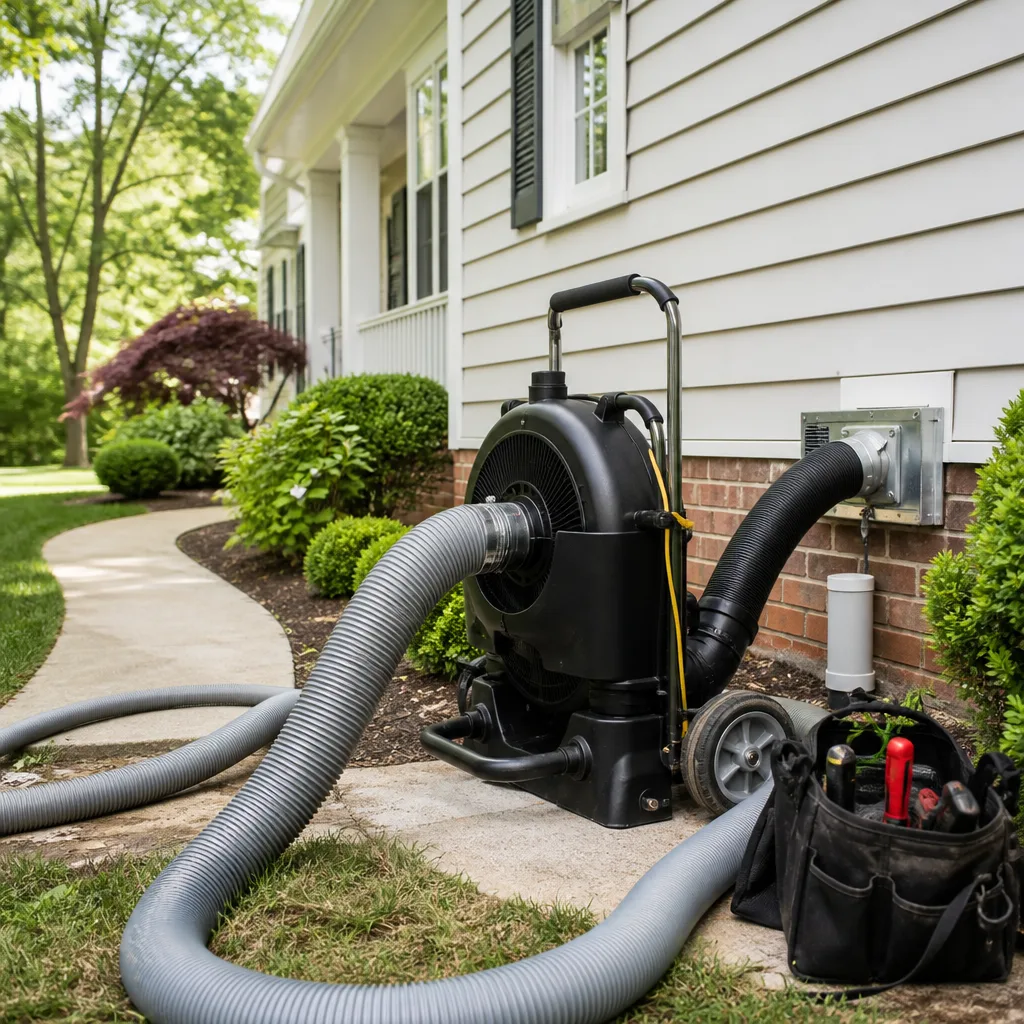 Whole-home duct cleaning
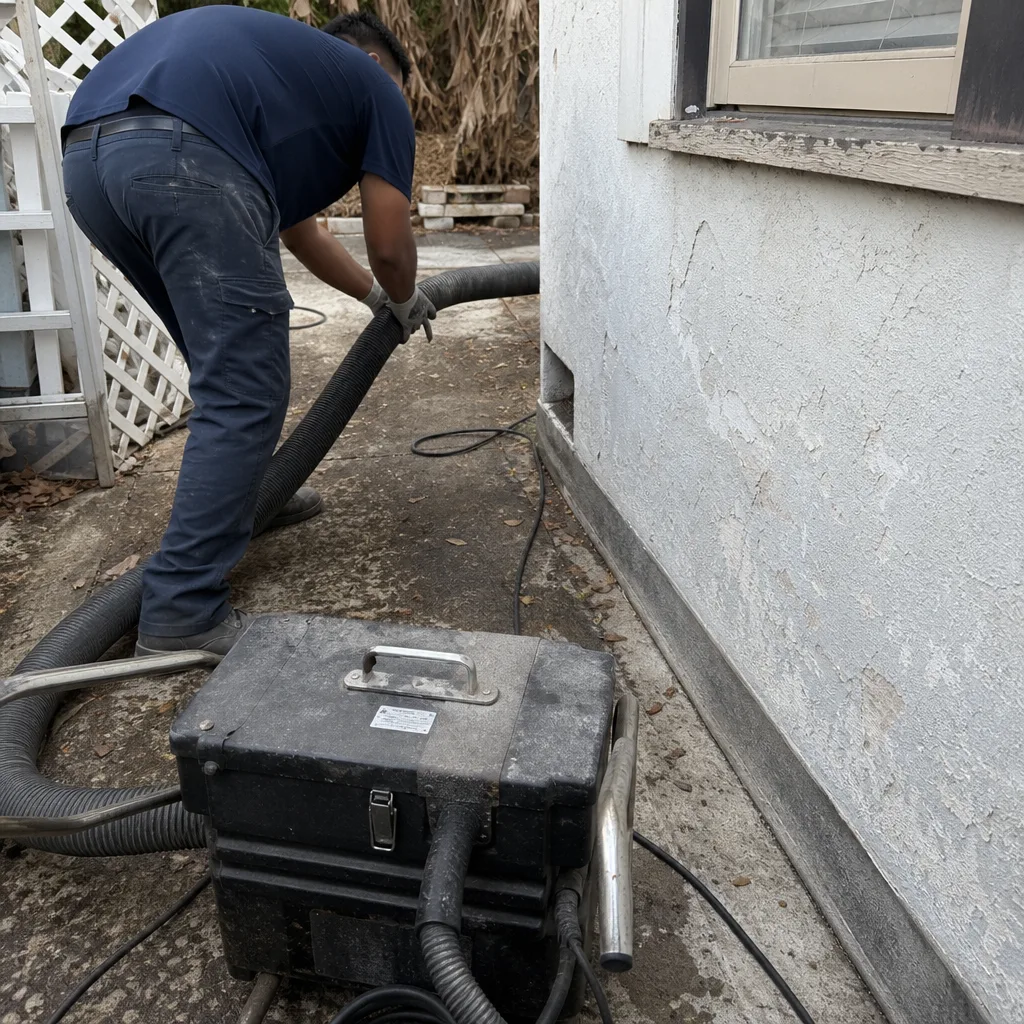
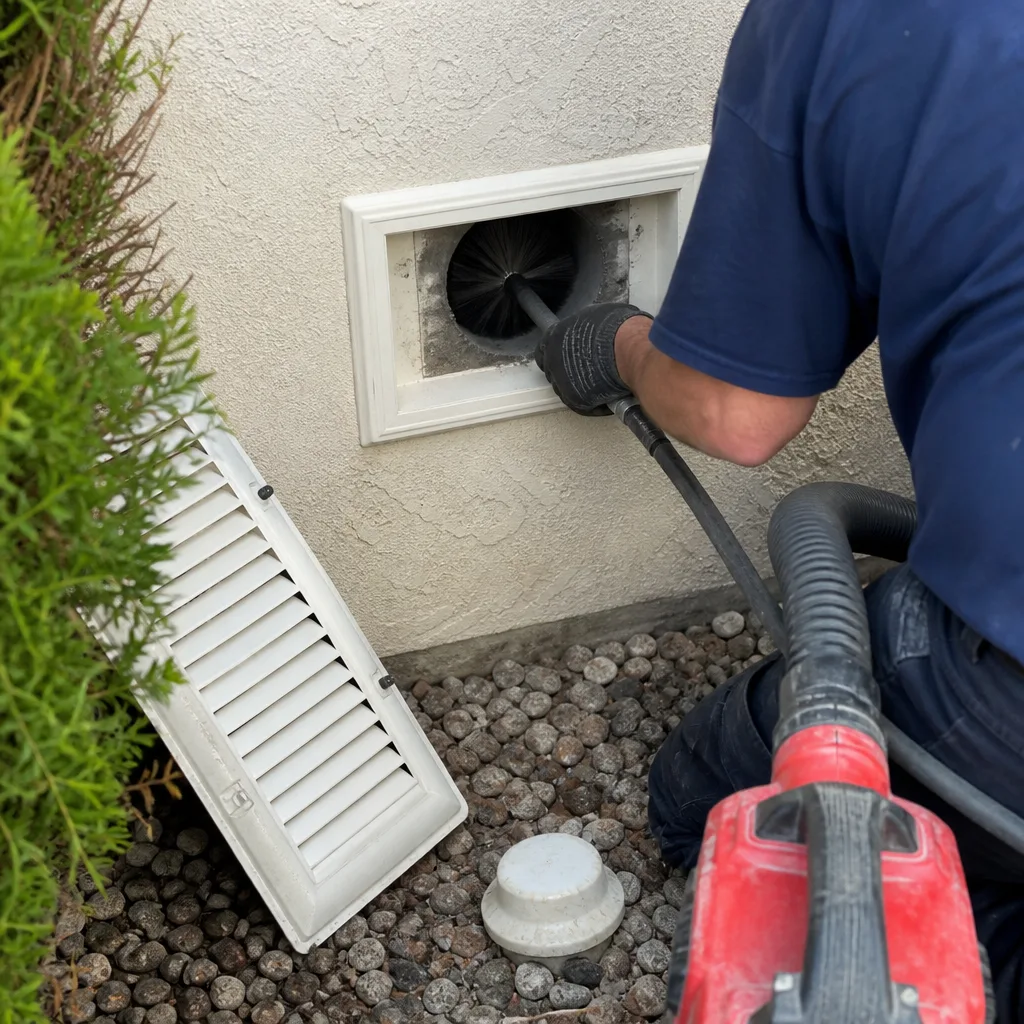
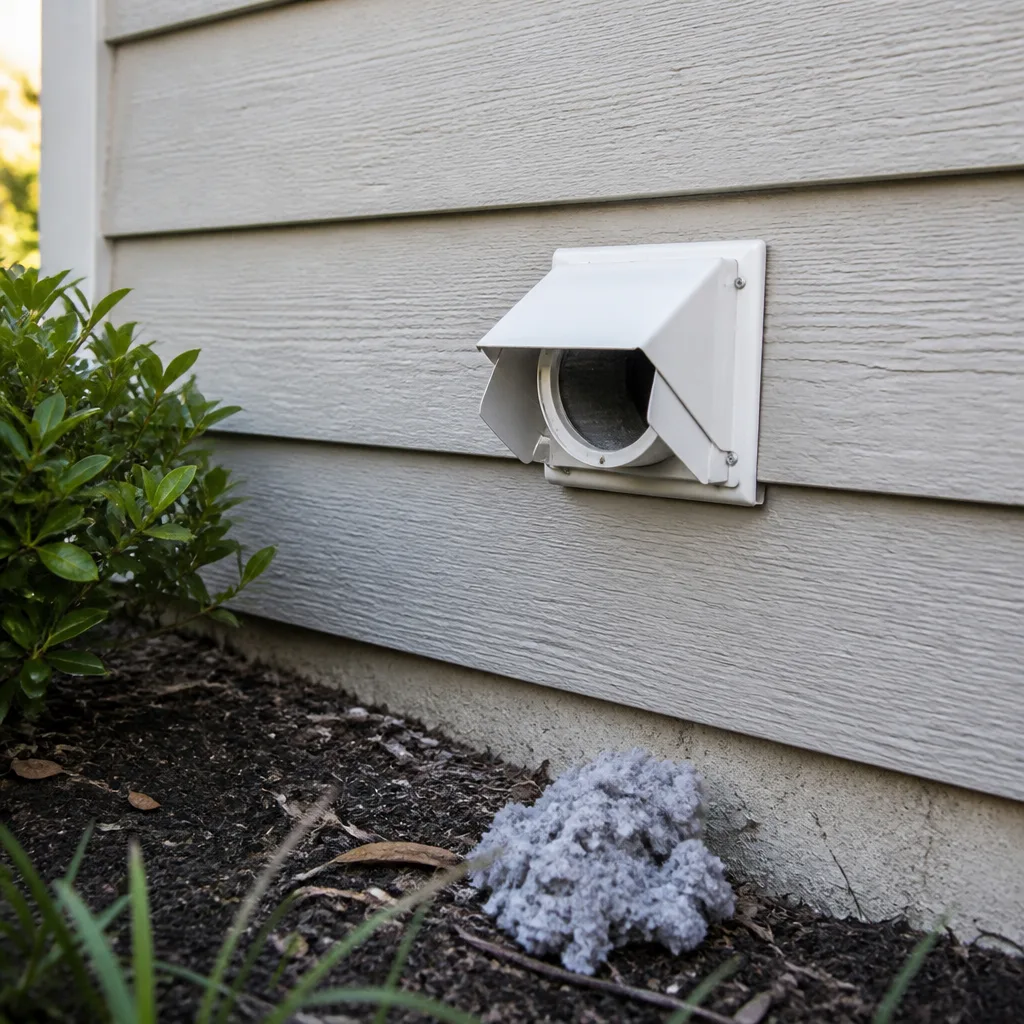 Dryer vent cleaning
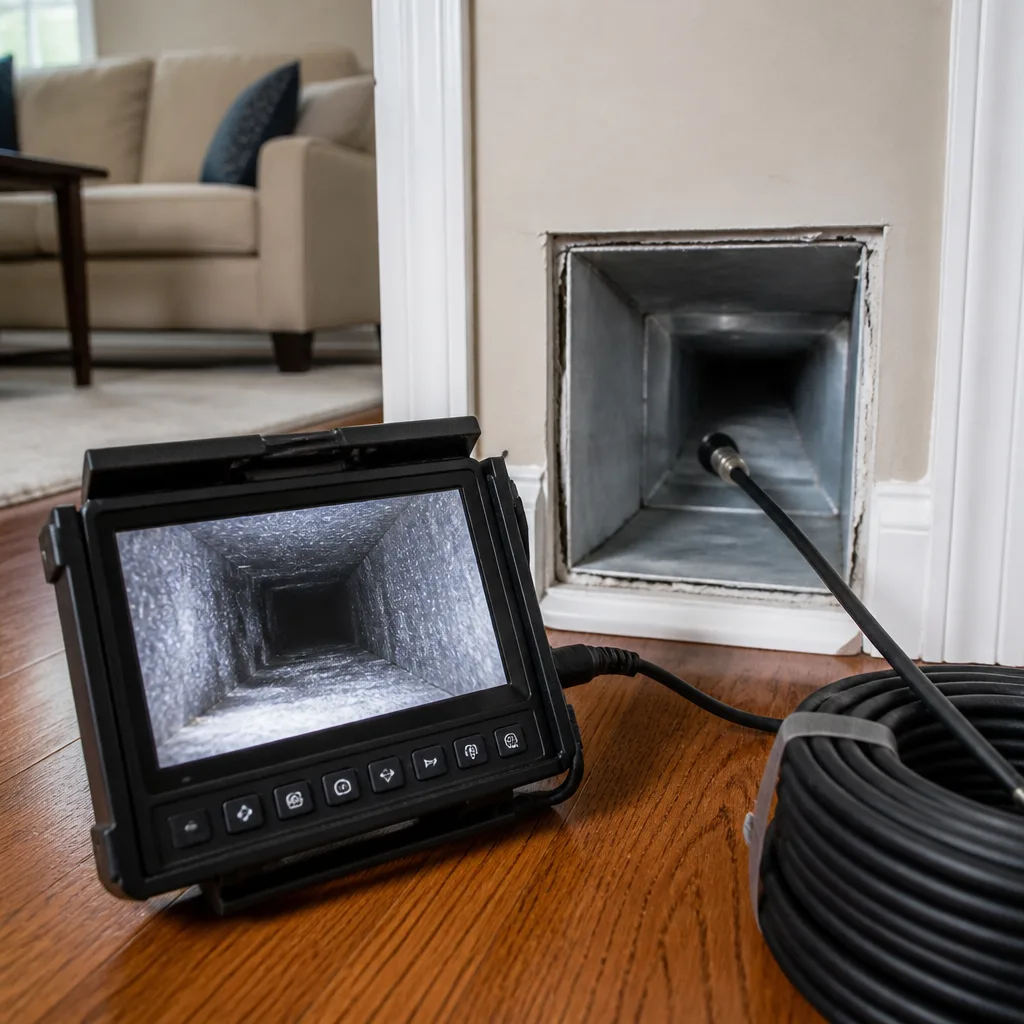 Camera inspection
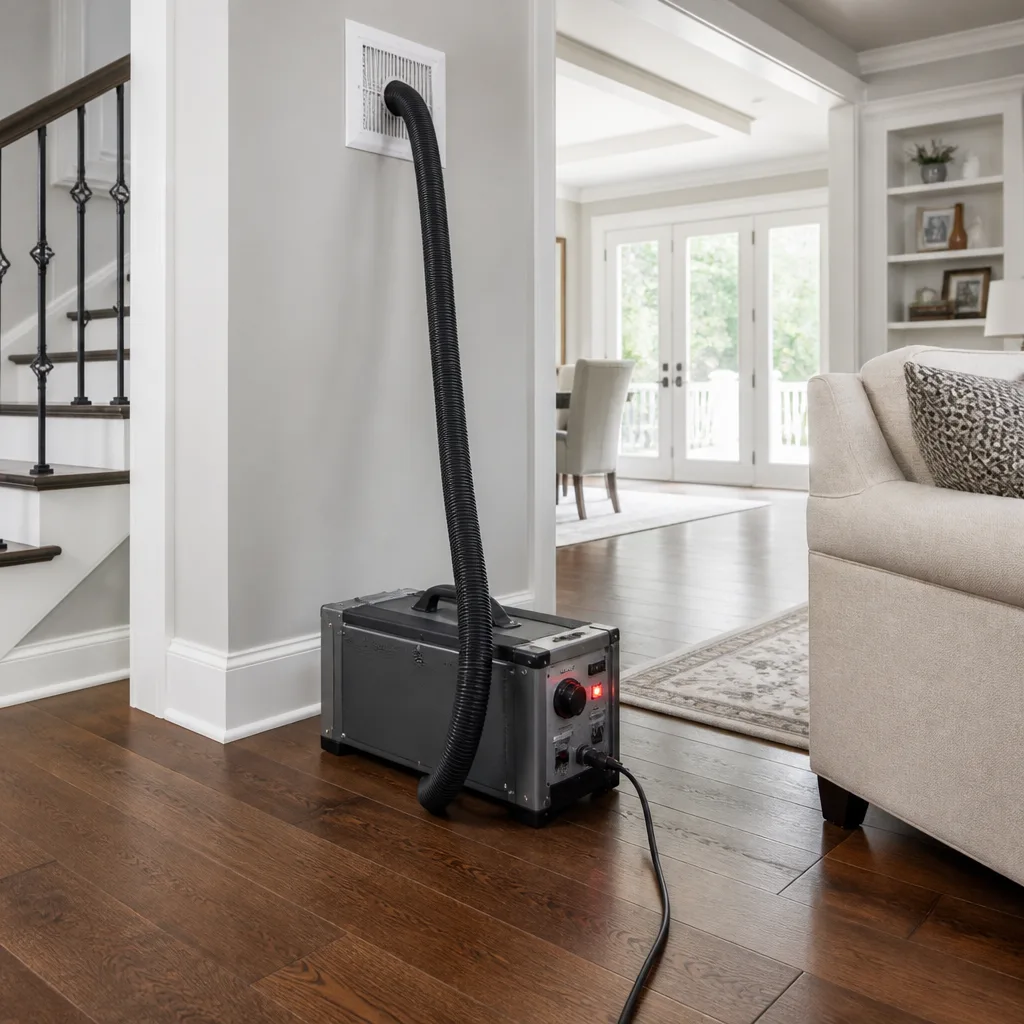 Sanitizing & deodorizing
Whole-system duct and dryer vent check with before-and-after photos - you see exactly what came out of your vents
That "$99 whole-house special" is a bait ad - the real number appears once they are in your hallway, or the "clean" is a shop-vac at the register. We photograph the inside of your ducts before and after instead.
How to Hire an Air Duct Cleaning Contractor in Santee: A Step-by-Step Guide
The $49 whole-house duct cleaning ad that lands in Santee mailboxes every spring is a legally operating scam. What it buys is a technician with a shop vac, a flashlight, and a commission structure designed to turn that $49 visit into an $800 bill before he leaves your driveway. This guide exists because most homeowners in Santee have never read a duct cleaning scope of work, don’t know what a professional vacuum CFM rating looks like, and can’t tell the difference between a Rotobrush agitation system and a hardware-store drill attachment. By the time you finish reading, you’ll know exactly which questions to ask, how to verify a California contractor license in under two minutes, and how to read a quote line by line before signing anything.
Quick Answer
To hire our Air Duct Cleaning services in Santee, you should verify their California State License Board registration for the appropriate contracting class, ask four equipment-specific questions (vacuum CFM rating, agitation method, HEPA filtration, and camera inspection), require a written scope of work before any equipment enters your home, and reject any quote that uses flat-rate pricing without per-register line items. A legitimate operator in the Santee market will pass all of these checks without hesitation; a bait-and-switch crew will stall on at least two.
Styles & brands we work with
- Whole-home duct cleaning
- Dryer vent cleaning
- Camera inspection
- Sanitizing & deodorizing
Table of Contents
- Step 1: Verify the California Contractor License Before You Book
- Step 2: The Four Equipment Questions That Expose a Low-Quality Operator
- Step 3: How to Read a Duct Cleaning Quote Line by Line
- Step 4: What a Legitimate Pre-Work Walk-Through Looks Like
- Step 5: Red Flags Specific to the Santee and East County Market
- Step 6: Why the Written Scope Matters More Than the Price
- Step 7: How to Verify the Work Was Actually Done
- Common Mistakes to Avoid
- When to Call a Professional
- Frequently Asked Questions
- The Bottom Line
Step 1: Verify the California Contractor License Before You Book
California law requires anyone performing duct cleaning for hire to hold an active contractor’s license issued by the Contractors State License Board (CSLB). The relevant classification for duct work is typically C-20 (Warm-Air Heating, Ventilating and Air-Conditioning) because duct cleaning involves accessing and servicing the HVAC distribution system, not just wiping surfaces. A C-61/D-40 (Limited Specialty) classification can also apply specifically to duct cleaning in some cases. The point is this: a handyman without a CSLB number is not legally permitted to open your ducts in California, and hiring one exposes you to liability if damage occurs during the work.
Verification takes less than two minutes. Go to the CSLB website, enter the contractor’s license number or business name, and check three things. First, the license status must say “Active,” not “Expired” or “Suspended.” Second, the classification must actually cover duct work; a C-36 plumbing license does not authorize duct cleaning. Third, confirm the workers’ compensation insurance status matches what the company told you. If any of these three checks fails, end the conversation.
In our experience serving the Santee area, the unlicensed operator problem is worse here than in coastal communities because East County has a higher volume of newer construction and rental properties, which attract transient crews who move from city to city. Asking for a CSLB number before you even discuss pricing immediately filters out a significant percentage of the operators advertising in Santee. We recommend making this your first question on any phone call.
Step 2: The Four Equipment Questions That Expose a Low-Quality Operator
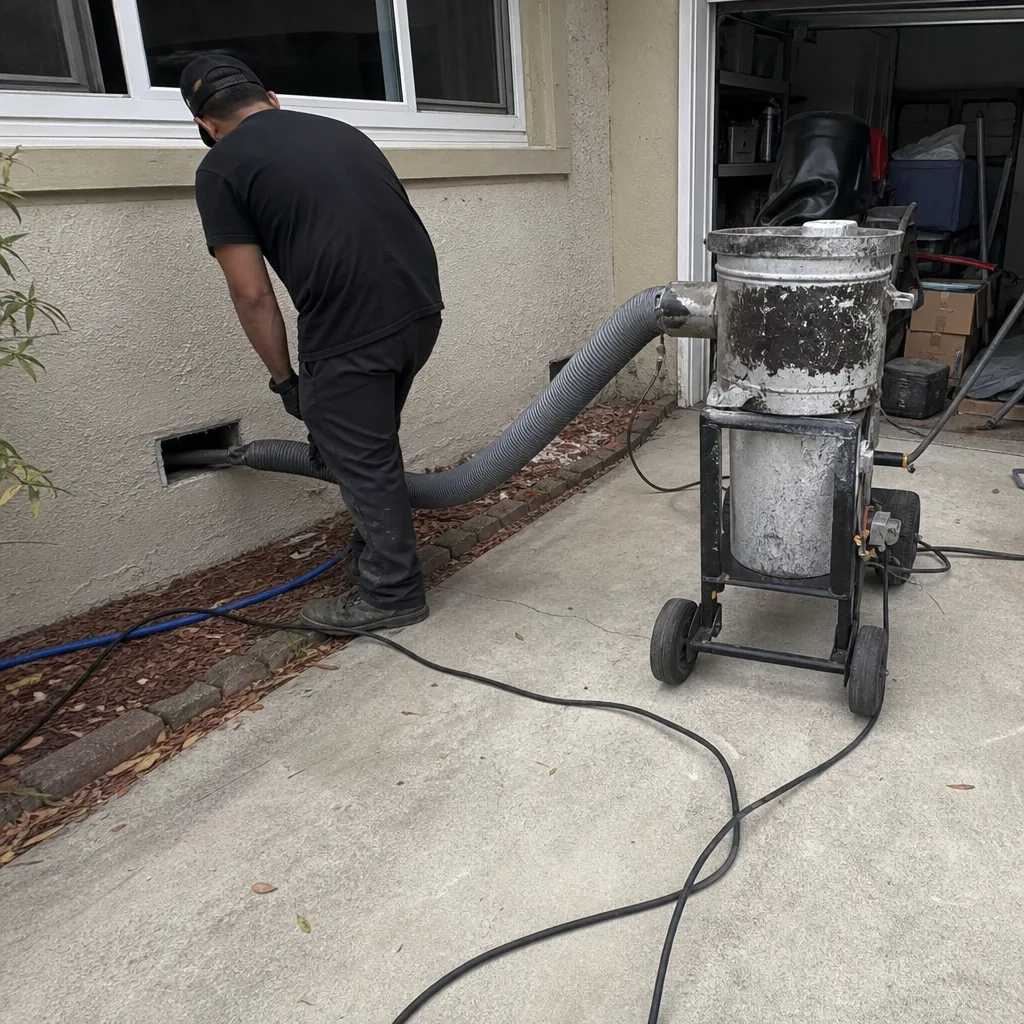
The single biggest difference between a professional duct cleaning company and a scam operator is what the equipment can actually do. A shop vac generates roughly 80 to 120 cubic feet per minute (CFM) of airflow. A professional-grade negative air machine used in commercial and restoration settings generates 2,000 to 5,000 CFM. The difference matters because duct cleaning works by creating enough negative pressure to pull loosened debris from the entire trunk line back to a central collection point. Underpowered equipment leaves dislodged dust in the duct system, where it blows into your living space the first time the furnace cycles.
These four questions will tell you everything you need to know:
- What is the CFM rating on your vacuum collection unit? A legitimate answer includes a specific number and a brand name. If the person on the phone does not know what CFM stands for, that is your answer. Professional units from brands like Abatement Technologies are engineered for containment-level work and produce airflow figures that a shop vac cannot approach.
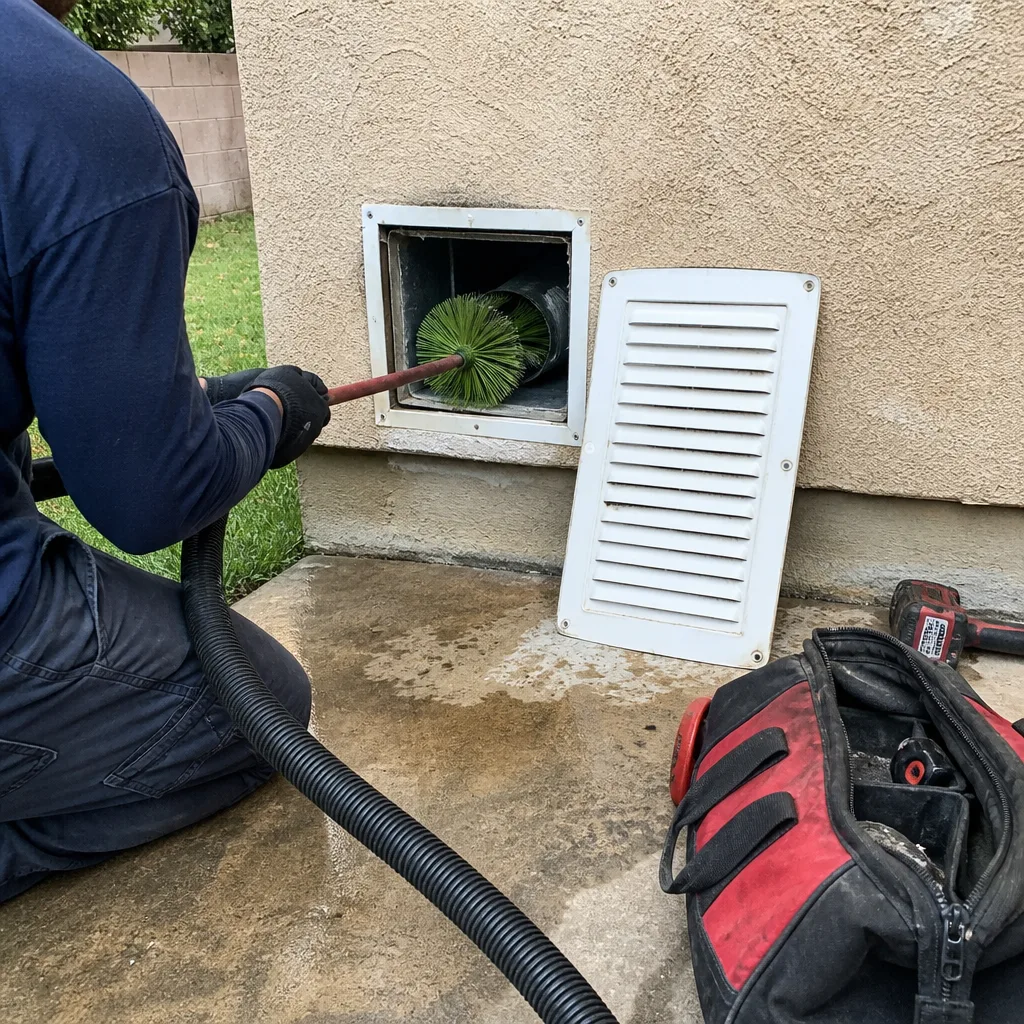
- What agitation method do you use to dislodge debris from the duct walls? Effective duct cleaning requires mechanical agitation, typically a rotating brush system. Ask what tool they use. Professional operators run powered brush systems such as Rotobrush equipment, which spins bristles against the duct interior to break loose the particulate layer. A crew that plans to “vacuum out” your ducts without agitation is performing an inspection, not a cleaning.
- Does your collection unit have HEPA filtration? This question separates real duct cleaning from dust redistribution. A HEPA filter traps 99.97% of particles at 0.3 microns, which means the air exhausted from the collection unit is cleaner than the air it pulled in. Without HEPA filtration, the machine is acting as a dust blower, circulating the same particles through your home at higher velocity.
- Do you bring a camera for pre- and post-inspection? If the answer is no, ask how they plan to show you what was removed. A legitimate operator in Santee should be able to show you photos or video of the duct interior before work begins and after it is complete. This is how you verify the job was done, not just paid for.
We run professional-grade equipment on every job we do in Santee because the alternative does not actually clean ducts. It moves dust around. And dust that stays in the system is dust your family breathes.
Step 3: How to Read a Duct Cleaning Quote Line by Line
A legitimate duct cleaning quote reads like a scope of work, not a coupon. The bait-and-switch model in the cleaning industry works because quotes are deliberately vague: one flat number with no detail about what it covers, what it excludes, and what happens when the technician finds damage. You should reject any quote that does not itemize the work.
A legitimate quote for a Santee home should include these line items:
- Total register count: The number of supply registers and return grilles to be cleaned, typically listed by room or per-floor. This should match the actual count in your home. In many Santee homes built in the 1970s and 1980s along Cuyamaca Street and in the Mast Park neighborhoods, the number ranges from 8 to 16 registers depending on square footage and whether the home has a second story.
- Main trunk line cleaning: The primary supply and return ducts running through the attic or crawl space. This is the bulk of the labor and should be explicitly stated.
- Supply plenum and return plenum: The sheet metal boxes at each end of the furnace. These collect significant debris and must be opened and cleaned; a quote that skips the plenums is leaving the dirtiest part of the system untouched.
- Blower fan and housing cleaning (optional but common): Some companies include this, some quote it separately. Ask what is included.
- Dryer vent cleaning (if applicable): If the quote makes no mention and you have not had the vent cleaned in over a year, ask for it. In Santee, a city with upward of 300 days of low humidity annually, dryer lint dries quickly and becomes an ignition risk in the vent line.
What you should not see is a flat price with no scope attached. “Whole-house duct cleaning: $399” without a register count, without mention of the trunk line or plenums, and without a written description of the cleaning method is a vehicle for upsell. The technician arrives, spends 20 minutes on a partial job, then announces that the “full clean” costs significantly more because the scope was never defined in writing.
When you call Duct Cleaning Santee home, you get a scope before you get a final number. That is how we believe every estimate in this industry should work.
Step 4: What a Legitimate Pre-Work Walk-Through Looks Like
Before any vacuum powers on in your Santee home, a legitimate contractor should conduct a walk-through that lasts at least 20 to 30 minutes. This is not optional time-filling; it is how the technician identifies the actual condition of your system and prevents surprises after work begins. If a crew shows up and starts pulling hoses off the truck within five minutes, that is a red flag.
- Furnace and coil inspection: The technician should locate the furnace, open the cabinet, and inspect the blower housing, evaporator coil if accessible, and filter condition. A dirty coil and a dirty blower indicate the system has been running without adequate filtration, which tells the technician what to expect inside the ducts.
- Register count and layout assessment: The technician counts every supply register and return grille in the home and maps the duct layout. This confirms the scope written on the quote matches reality, and it catches additions or modifications to the system that previous work may have missed.
- Access point identification: Duct cleaning in most Santee homes requires access through the furnace cabinet, a return drop, or a trunk line opening. The technician should explain where each access point will be and why. This matters because the access holes must be resealed properly afterward; a crew that leaves gaps in the return plenum creates a system that pulls attic air directly into the living space.
- Visible damage documentation: If the technician spots separated duct runs, crushed flex duct, or gaps at fittings, these should be noted and shown to you before cleaning begins. You need to know about this because cleaning a damaged duct is ineffective; the negative pressure pulls dust and attic insulation through the gap. A company that can perform Air Duct Repair in Santee will address this at the same visit, while a cleaning-only operator will shrug and finish the job.
- Written scope confirmation: The final step before work starts is a signed scope that states exactly what will be cleaned, how many registers, what ancillary work is included, and what the final price will be. You sign this before the equipment turns on. If a company will not put the scope in writing, do not let them start.
This walk-through is the difference between hiring a specialist and hiring a technician whose primary skill is reading a sales script. In Santee, where many homes in the Sky Ranch and Eden Ranch communities sit on lots with significant landscaping and outdoor dust, the condition of the duct system varies widely from house to house. A real assessment matters more than a generic checklist.
Step 5: Red Flags Specific to the Santee and East County Market
Every market has its own version of the duct cleaning bait-and-switch operation, and Santee’s has a particular shape. We have seen patterns in the calls we receive from homeowners who initially hired someone else, and these are the warning signs that cluster in the 92071 ZIP code and surrounding East County communities.
- Same-day subcontracting: A company that books you for Tuesday and sends a crew you have never spoken to, driving a truck with a different name on the door, is brokering the job. The salesperson on the phone has no control over the quality of work performed, and any guarantee they gave you is not worth the paper it was not written on. Ask who will be performing the work and whether they are employees of the company you are paying.
- No physical address near Santee: A legitimate duct cleaning company serving Santee has a physical presence in or near East County. If the business address is a P.O. box in another state or a strip mall in a city 60 miles north, understand what that means: the company runs a rotating crew model where technicians are dispatched from wherever demand exists that day. This is common in the duct cleaning sector, and it is how low-quality operators stay one step ahead of their reputation.
- Review clusters: A company with 40 five-star reviews, all posted within a single 30-day window, is likely running a review generation campaign to cover a bad reputation or launch a new brand. Look for a review pattern that stretches over years and includes detail: what kind of equipment was used, whether the technician explained the scope, whether the price matched the final bill. A review that says “great job, very professional” with no detail tells you nothing about duct cleaning competence.
- Mailer pricing that defies physics: The $49 or $69 whole-house offer is not a loss leader; it is a bait. The cost of driving a truck, a technician, and professional equipment to a Santee home exceeds the coupon price before anyone touches a duct. The business model recovers that cost through mandatory upsells, and the hourly economics create enormous pressure on the technician to sell, not clean.
The pattern unravels under direct questioning. Ask what equipment they use, ask for a written scope before booking, and watch how quickly the price changes.
Step 6: Why the Written Scope Matters More Than the Price
The most important document in a duct cleaning transaction is not the quote. It is the scope of work, and the two are not the same thing. A quote tells you a number; a scope tells you what that number buys. The bait-and-switch model works by keeping the scope vague, because a vague scope means the technician on site has the power to redefine the job once he is standing in your hallway with a clipboard and a look of concern.
A proper scope for a Santee home includes the specific number of registers, the identification of all trunk lines to be cleaned, whether the return plenum and supply plenum are included, whether the blower housing is being cleaned, and whether dryer vent service is part of the work or an add-on. It also states the cleaning method and the equipment to be used. This is not paperwork for the sake of it. A written scope means both parties agree on what finished looks like before the work begins, and it eliminates the most common upsell pressure point: the technician “discovering” that extra work is needed that is somehow not covered by the original price.
We provide a written scope on every job. It is the same standard used in commercial and restoration work, where vague scopes do not survive the bid process. Homeowners deserve the same clarity.
Step 7: How to Verify the Work Was Actually Done
Once the truck pulls away from your Santee home, how do you know the ducts were actually cleaned? This is the question most homeowners never ask because they do not know what to look for. Here are the verification methods that matter.
What to ask for before the technician leaves:
- Before-and-after photos or video: A camera inspection of the main trunk line and return plenum should be standard on a professional job. You should see the duct interior before cleaning, coated with dust and debris, and after cleaning, with sheet metal or flex duct visible. If the company does not have this, you have no evidence the work was performed beyond a receipt.
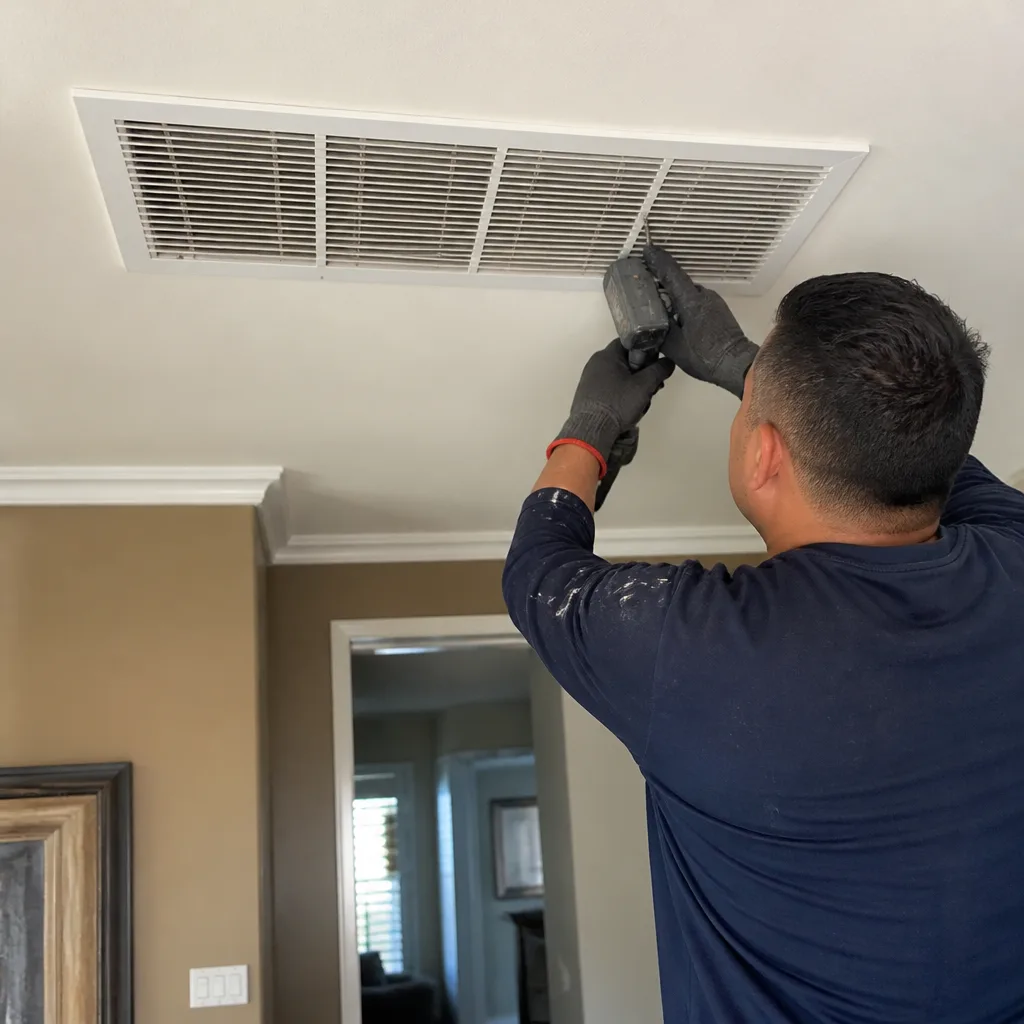
- Visual confirmation at the registers: Remove a few supply registers after the work is done and shine a flashlight into the duct boot. The immediate area should be free of accumulated dust. You are not looking for a sterile surface; duct interiors have texture and minor staining is normal. But thick dust accumulations should be gone.
- Filter check after two weeks: Install a clean furnace filter the day of the cleaning, then check it after two weeks. If the system was properly cleaned, the filter should not be packed with debris. A rapid buildup means the cleaning was ineffective or there is a gap in the return duct drawing in attic air. This is a real-world test that does not lie.
- Confirm the access points are sealed: If the technician cut access holes in the plenum or trunk line, those openings should be resealed with sheet metal caps and foil tape, not left open or patched with duct tape. Open access points pull attic air into your system, which is a direct indoor air quality problem.
If a company cannot produce evidence of the work or avoids answering verification questions, you now know what to look for in a different contractor next time. On the home page of our site, we explain the full Air Duct Cleaning in Santee process in detail.
Comparing Your Options: Three Tiers of Duct Cleaning in Santee
Not every duct cleaning operator in the Santee market is a scam, and not every expensive quote is a good one. The market splits into three rough tiers, and understanding where a given quote falls helps you make an informed decision. For Air Duct Cleaning Cost Breakdown: The Santee Homeowner’s Reference for 2026, see our detailed pricing guide.
- Tier 1: The coupon operator. Whole-house pricing under $150, no written scope, vague answers to equipment questions. This is the bait-and-switch model. The technician is paid on commission and the job is a sales call with a vacuum attached. Avoid entirely.
- Tier 2: The generalist HVAC company. Duct cleaning is an add-on service for a furnace replacement or repair company. The technician is licensed and the company is legitimate, but duct cleaning is not the core competency. Equipment is often a portable unit designed for spot cleaning rather than whole-system extraction. This tier can produce decent results if the company invests in proper equipment, but it is inconsistent from job to job.
- Tier 3: The duct-focused specialist. The company does one thing: duct and ventilation work. Equipment is professional grade and designed for whole-system negative air with mechanical agitation. The technician does duct work every day, not once a month. This is the tier where you find the highest consistency from job to job.
We are firmly in the third tier. Our entire operation is built around duct system health: Dryer Vent Cleaning in Santee, air duct cleaning, and duct repair. We do not install furnaces, we do not repair refrigerators, and we do not branch out into plumbing. That singular focus is the only way to justify the equipment investment required to do this properly.
Common Mistakes to Avoid
- Hiring based on the lowest price without reading the scope. The coupon model in duct cleaning is designed to convert a low entry price into a high final bill. If the scope is not itemized, the price means nothing because the job itself is undefined.
- Assuming a furnace company is automatically good at duct cleaning. They are different skill sets. Duct cleaning requires specific negative-air equipment and agitation tools that general HVAC companies often do not own. No knock on furnace installers; it is simply not their job.
- Skipping the CSLB license check. Two minutes of verification on the state website protects you from liability if a technician damages your duct system and the company has no insurance. Unlicensed operators disappear when something goes wrong.
- Accepting a quote over the phone without a home visit. Duct systems in Santee vary significantly based on the home’s age, layout, and previous renovations. A phone quote without a physical inspection is a placeholder number, not a final price.
- Not asking about dryer vent cleaning. Dryer vents are a leading cause of residential structure fires in the United States, and the risk is higher in dry climates like Santee’s. A duct cleaning that does not address the dryer vent is an incomplete safety assessment.
- Believing that visible dust on registers means the ducts need cleaning. Surface dust at registers is normal and often the result of the home’s natural dust load passing through the grille. Duct cleaning should be scheduled based on the condition inside the trunk lines and plenums, not on what accumulates at the register face within a week.
When to Call a Professional
You should call a professional duct cleaning contractor when you see visible dust blowing from registers when the system starts, when you find thick dust accumulation inside the register boots when you peek in with a flashlight, when family members experience unexplained allergy or respiratory symptoms that worsen when the HVAC runs, or when the home has recently undergone remodeling that produced drywall or wood dust. Long dryer cycles are a separate signal; if a load of towels takes more than 60 minutes to dry, the dryer vent may be restricted. Duct cleaning is not an annual necessity for most homes, but it is a legitimate maintenance item every three to five years depending on household conditions. When the time comes, choose a contractor who passes the checks in this guide. Duct Cleaning Santee offers free estimates in Santee. Call (833) 542-0752 and ask for a written scope before any work begins.
Frequently Asked Questions
Air duct cleaning in Santee typically costs between $350 and $650 for a standard single-family home with 10 to 14 registers, with larger homes rising above that range. The price varies based on the number of registers, the number of trunk lines, accessibility of the plenums, and whether dryer vent cleaning is included. Any price below $150 for a whole-home cleaning is a bait price, not a real quote. Call (833) 542-0752 for a free, itemized estimate specific to your home in Santee.
Cheap duct cleaning quotes are cheap because the company is not actually planning to clean your entire duct system at that price. The technician is typically paid on commission and the low price is a door-opener, with the real revenue generated through upsells after the work begins. Professional duct cleaning requires equipment that costs tens of thousands of dollars, and the operating cost per job cannot be covered by a $49 or $69 fee. A legitimate company prices the job honestly up front, which means the quote will be higher but the final bill will match the quote.
You know the work was done by requiring before-and-after photos or video of the duct interior, by visually inspecting register boots with a flashlight after the job, and by checking your furnace filter after two weeks of normal operation. A properly cleaned system should leave visible sheet metal or clean flex duct in the before-and-after images, and your new filter should not be packed with debris within the first month. If a company cannot provide visual evidence, you have no way to confirm the work was performed.
Most homes in Santee benefit from Seasonal Air Duct Cleaning Care for Santee: Year-Round Homeowner’s Guide every three to five years, though homes with pets, smokers, recent remodeling, or occupants with severe allergies may need cleaning more frequently. The EPA does not mandate a specific interval, and the decision should be based on the actual condition of the duct interior rather than a calendar. A camera inspection during a walk-through will show you whether your ducts have accumulated enough debris to justify cleaning now or whether you can wait another year or two.
Duct cleaning can help reduce allergy symptoms if the duct system has accumulated significant dust, dander, or particulate that recirculates through the home when the HVAC runs. It is not a cure, and it works best as part of a broader indoor air quality strategy that includes regular filter changes and potentially a whole-home air cleaner. Homes in Santee with pets, older duct systems, or residents who react to dust tend to see the most noticeable improvement. If allergies are a primary concern, ask about filter upgrades and air quality equipment during the estimate.
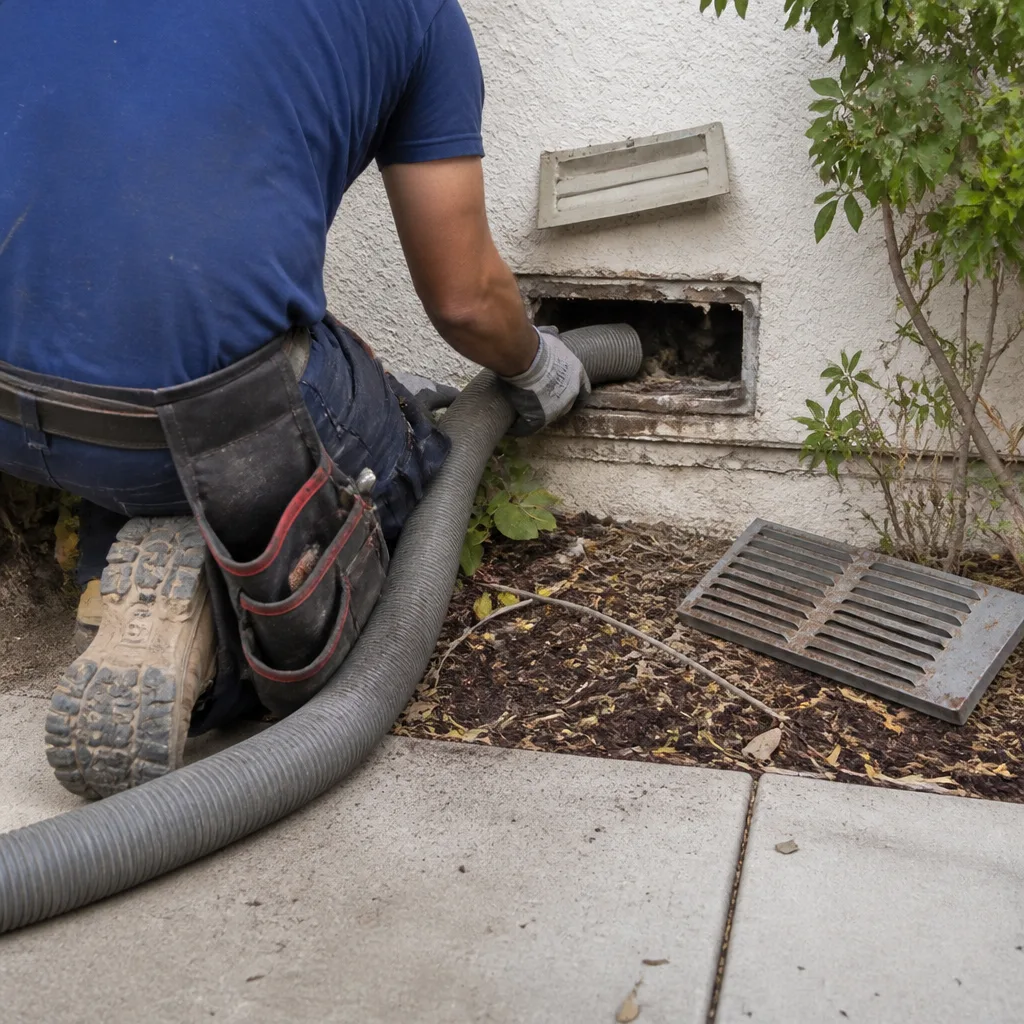
No, dryer vent cleaning and air duct cleaning are separate services that address different systems in your home. Air duct cleaning addresses the HVAC distribution system, including supply and return ducts, plenums, and the blower. Dryer vent cleaning addresses the dedicated exhaust line running from your dryer to the exterior, which accumulates lint and becomes a fire risk over time. A full duct-system health assessment should include both, and a contractor who treats them as a single bundled item may not be giving either service the attention it requires. Call (833) 542-0752 to discuss both services with our team in Santee.
The Bottom Line
Hiring a duct cleaning contractor in Santee comes down to verification, not trust. Verify the CSLB license, verify the equipment, verify the scope, and verify the results. Ask the four equipment questions before you book, refuse any quote without line items, and require a written scope before the vacuum turns on. A legitimate operator passes every one of these checks without hesitation and can show you evidence of the work when it is done. A bait-and-switch operation will stall, deflect, and pressure you on price. The difference is worth the effort because this is about what your family is breathing every time the HVAC runs. Do it once, do it right, and call (833) 542-0752 when you are ready for a free estimate from a company that does this one thing and does it with professional equipment on every job. For more guides & resources, visit our blog.
Written by the team at Duct Cleaning Santee, serving Santee since 2017.
See the difference
 Before
 After
 Before
 After
 Before
 After