
Emergency Air Duct Cleaning Near Me: What Santee Homeowners Should Do First
If you’ve just discovered a dead rodent in your duct system or visible mold near a register, the single worst thing you can do is keep running your HVAC while you wait for a cleaning appointment. Shut the system down first, then contain, then call. That sequencing, negative-pressure containment before debris removal, is what separates emergency remediation from a standard cleaning, and it’s the difference between a contained problem and a house-wide contamination event. If you’d rather not handle the first steps alone, call us at (833) 542-0752 and we’ll walk you through it.
In our experience across Santee, most calls labeled “emergency duct cleaning” aren’t routine buildup situations. They fall into one of three actual emergencies: rodent intrusion, post-flood or condensate moisture growth, or wildfire smoke infiltration. Each one has a different correct first response, and none of them start with “book the next available duct cleaner.” Acting out of sequence spreads contamination rather than containing it.
The Three Real Emergencies Behind “Emergency Duct Cleaning” in Santee
When a Santee homeowner searches “emergency air duct cleaning near me,” the situation behind that search is almost always one of three scenarios. We’re going to walk through each, because the correct first move is different for every one.
1. Rodent Intrusion: Shut It Down, Do Not Run the Fan
A dead rodent in a duct is not a cleaning problem. It’s a contamination problem with a cleaning component. If you smell decay coming from your vents, or worse, you’ve confirmed a carcass in a register or return, shut the HVAC off at the thermostat immediately. Then kill power at the breaker. Do not run the fan on “on” mode to try to air things out. That fan will aerosolize bacteria, dander, dried fecal matter, and whatever else is in that duct, and distribute it through every room the system serves.
After shutdown, close every supply register in the house manually. This creates a passive barrier that slows the migration of contaminated air into living spaces. Then assess entry points. A rodent got in somewhere: a disconnected duct in the crawlspace, a torn flex run, a missing screen on an exterior vent, a gap where the plenum meets the wall. If you skip that assessment and just clean the ducts, the problem returns next week with a new occupant.
This is where Air Duct Cleaning in Santee merges with the repair side of what we do. Cleaning removes what the rodent left behind. Sealing the entry point is what keeps it from happening again. A cleaning-only company will hand you a fresh system and a repeat performance. The emergency response has to include both.
2. Water Intrusion or Condensate Overflow: Moisture Mapping Before Disturbance
Santee’s hot, dry summers push AC systems hard. Condensate drain lines clog, drip pans overflow, and water ends up where it shouldn’t be: inside insulated duct runs, inside the supply plenum, soaking the interior insulation of your system. You might notice a musty smell that gets stronger when the AC cycles, water staining around a ceiling register, or sagging flex duct in the attic or garage.
The wrong response is to immediately start cleaning. Disturbing wet, mold-contaminated duct insulation before you know the moisture boundary sends spores airborne and spreads the problem to dry sections of the system. The correct first response is moisture mapping. A technician should determine exactly how far water traveled before any cleaning equipment gets switched on. That means cameras in the ducts, moisture meters on the insulation, and a visual inspection log that documents the extent of damage before and after.
We use camera inspection equipment on every emergency call, not just the big ones. You cannot do moisture mapping by guesswork. And the inspection log matters for another reason: if you’re filing an insurance claim, the adjuster wants to see a scope of work that uses remediation language, not maintenance language. We’ll cover that more below.
3. Wildfire Smoke: MERV Filtration Triage vs. Full Cleaning
Santee sits close enough to East County wildfire zones that smoke events are a recurring reality. After a significant smoke week, homeowners call us with two questions: “Do my ducts need cleaning?” and “Can you do it this week?” The honest answer to the first question is: maybe not. And the answer to the second is: it depends on what a camera inspection finds.
Smoke is particulate matter. Much of it gets captured by your return filter before it ever enters the ducts. What does enter the ducts tends to accumulate as a fine film on the interior surfaces, and the amount depends on how much you ran the system during the smoke event, what your filter situation was, and how tight your ductwork is. Here’s the triage framework we use:
- If you have a standard 1-inch fiberglass filter and ran the system heavily during the smoke event, you likely have meaningful smoke deposition in your ducts and a cleaning is justified.
- If you have a high-MERV filter (MERV 11 or higher) and changed it promptly after the smoke cleared, you may not need a full cleaning at all. A camera inspection confirms it.
- If your system shows only light smoke film on the return side but not the supply side, the correct response may be a filter upgrade and a shorter targeted cleaning rather than a full system clean.
What you don’t want is a company that quotes a full emergency cleaning over the phone without ever looking at the system. That’s the duct-cleaning equivalent of prescribing surgery without an exam.
How to Shut Down Your HVAC System Correctly
In an emergency, the shutdown sequence matters. You’re trying to stop the system from distributing contamination while you wait for a professional. Here’s the order we recommend to every Santee homeowner who calls us mid-panic:
- Turn the system to “off” at the thermostat. This stops the blower from cycling. Do not set it to “fan on.” Do not set it to a lower temperature thinking that will help.
- Kill power at the breaker. The furnace or air handler breaker is typically labeled. Flip it. This prevents any automatic fan operation, defrost cycles, or smart-thermostat overrides from starting the blower.
- Close every supply register in the house. This is the passive containment step. It won’t create a perfect seal, but it slows air migration through the ductwork and reduces the chance of contaminated air drifting into living spaces.
- Do not open the air handler cabinet or furnace door. If mold or rodent contamination is inside the unit itself, opening the cabinet without containment releases it directly into the room you’re standing in. Leave that to someone with negative-pressure equipment.
These four steps buy you containment time between discovery and the technician’s arrival. In Santee, where summer temperatures climb into the 90s and beyond, shutting off the AC for a day is uncomfortable. It’s also better than running contaminated air through the whole house. We tell customers the same thing: a hot afternoon is an inconvenience. A fully contaminated duct system is a remediation that costs five times as much.
What a Legitimate Emergency Duct Response Actually Looks Like
You should know what to expect when an emergency duct company arrives, because the gap between a real emergency response and a standard cleaning sold as an emergency is where Santee homeowners get taken advantage of. Here’s what a proper emergency visit includes that a standard cleaning skips.
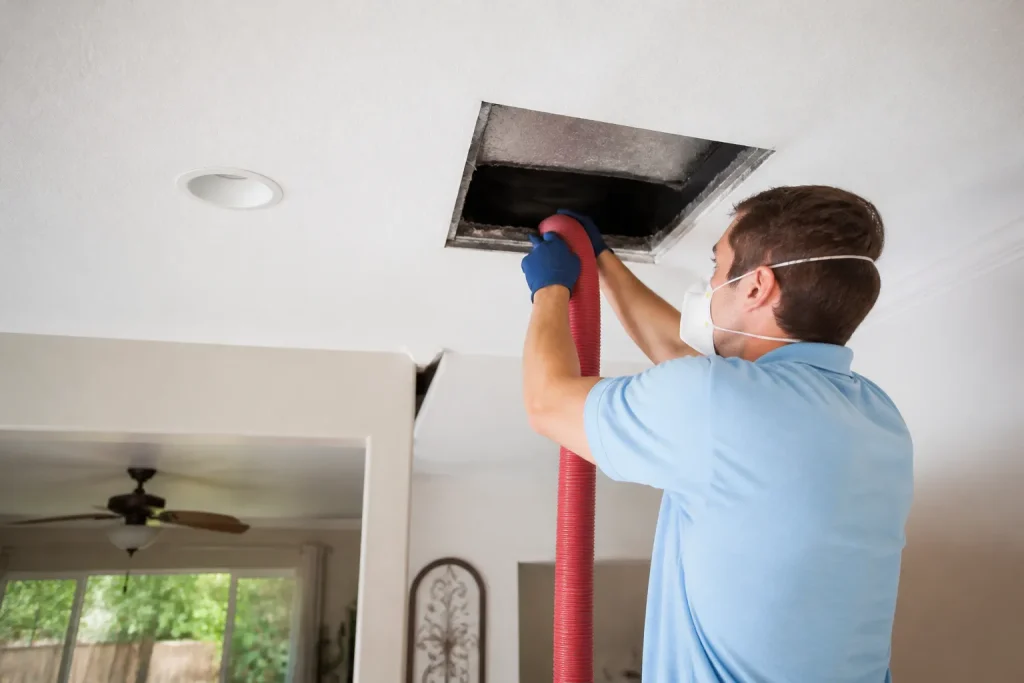
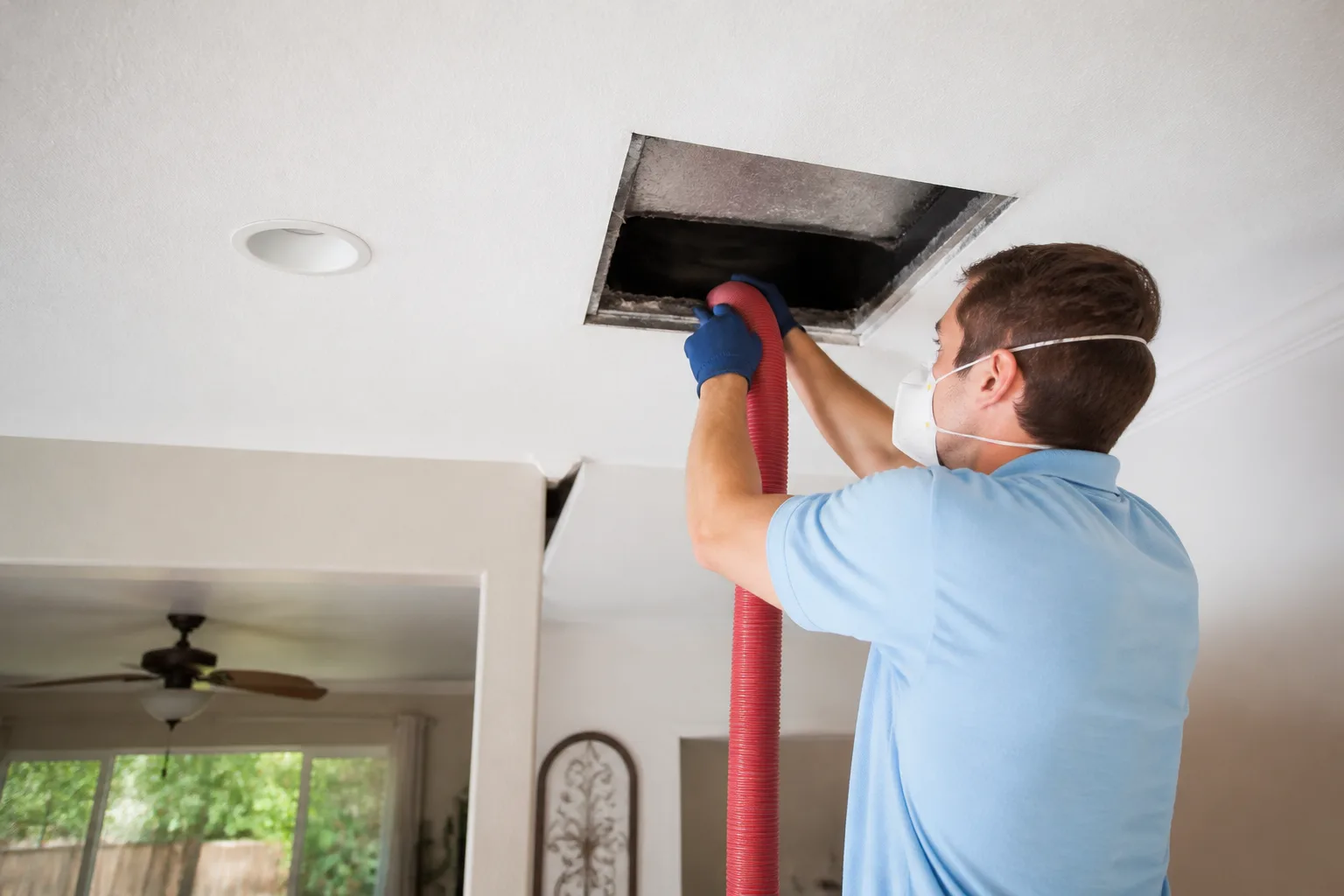
Containment verification. Before any cleaning starts, the technician should verify that the affected area is contained. That means sealing off supply and return openings in the work zone, setting up negative air pressure so that any dislodged debris is pulled into the equipment rather than escaping into the house. This is why we run Abatement Technologies negative air machines on contamination jobs. It’s the same containment approach used in restoration and remediation work, and it should be non-negotiable for any emergency involving mold, rodent remains, or heavy soot.
Pre-cleaning visual inspection and documentation. A camera goes into the ducts before cleaning begins. The homeowner should see the footage. The technician should log what was found, where it was found, and what it looked like before work started. This log is your before-and-after record, and if you’re filing an insurance claim, it’s the evidence that establishes the scope of the problem.
Insurance-grade documentation. For water intrusion and wildfire smoke events, Santee homeowners may have a legitimate insurance claim for duct remediation. But here’s the catch: the claim has to be written as remediation, not maintenance. If the contractor’s scope of work says “standard air duct cleaning,” the adjuster will deny it as routine upkeep. If it says “microbial growth remediation following Category 2 water intrusion into supply ductwork,” that’s a different conversation. The language on the paperwork shapes whether the claim is approved.
Equipment that can actually do the job. Emergency remediation requires professional-grade machinery. We run Rotobrush and Nikro cleaning systems because they’re built for heavy contamination: rodent debris, mold on duct surfaces, fine smoke particulate. Consumer-grade or low-powered equipment that a generalist might carry simply cannot achieve the contact agitation and HEPA-level collection that emergency situations demand. There’s a reason those two brands show up in commercial and restoration environments: they work under conditions where the margin for error is zero.
Red Flags in “Emergency” Responses
A real emergency response is different from a standard visit. But the duct cleaning industry has a reputation problem, and the emergency category is where the worst operators hide. Here’s what should make you hesitate before a Santee emergency duct company parks in your driveway.
No camera inspection equipment. If the technician cannot show you the inside of your ducts on-screen before and after, you have no way to verify the work was done. A camera is basic diagnostic equipment in 2025. A company that cleans emergency contamination without one is asking you to trust them on faith, and faith is not a verification method.
No containment setup. If the crew shows up with a shop vac and a rotating brush and that’s the whole show, that’s a standard cleaning, not a remediation. Emergency scenarios involving mold or rodent contamination require negative air pressure and sealed work zones. Without containment, the cleaning itself becomes a distribution event.
Full “clean” in under 90 minutes. A thorough cleaning of an average Santee single-family home takes hours. Duct-by-duct cleaning, coil and blower chamber attention, register cleaning, final camera verification: it’s not a 75-minute job. If someone calls it an emergency and is packed up before lunch, you paid for a maintenance visit.
Immediate upsell to unrelated services. A duct company that arrives for an emergency and quickly starts pitching furnace replacement, whole-home water filtration deals, or “this system is too old to clean” is using the emergency as a sales wedge. Our scope is ducts, vents, and the air moving through them. That focus exists for a reason: every tool we carry and every technician we train is purpose-built for this one trade. When a company does everything, the emergency response you needed becomes the lead-generation moment they wanted.
When to Call a Pro (And When to Wait)
If you’ve confirmed rodent intrusion, visible mold, standing water in the duct, or a significant wildfire smoke event, call a professional before you run the system again. These are containment situations, and containment requires equipment and training. We cleaned one system over by the Walker Preserve neighborhood last year where the homeowner had been running the fan for three days after noticing a smell. The fan had distributed rodent debris through every supply run. What would have been a localized containment job turned into a full-system remediation and insulation replacement. The shutdown sequence matters.
If you’ve noticed increased dust, slightly reduced airflow, or a home that feels stuffier than usual but there’s no active contamination event, that’s a standard cleaning situation, not an emergency. Those can be scheduled like any other service. The distinction is whether contamination is actively entering your living space or not.
Related services in Santee: Dryer Vent Cleaning in Santee and Air Duct Repair in Santee. Emergency situations often reveal damage that needs both cleaning and repair, and knowing what a company can actually do, beyond just cleaning, shapes the scope of work you get.
The Bottom Line
“Emergency air duct cleaning” in Santee nearly always means one of three things: a rodent died in your ducts, water got into your ducts and something is growing, or wildfire smoke worked its way through your system. Each has a different correct first response, but all three share one rule: shut the system down before anything else, then contain, then clean. Skip the sequence and you spread the problem. That’s the difference between a $500 targeted job and a $4,000 whole-system remediation. If you’re in Santee and you’re staring at an active contamination situation, call us at (833) 542-0752. We’ll walk you through the shutdown steps over the phone and schedule an emergency visit with camera inspection, containment equipment, and a real remediation plan, not just a brush and a vacuum.
If this all sounds like more than you want to handle on your own, it’s exactly the kind of situation we deal with every week. Duct Cleaning Santee home services cover the full range: emergency cleaning, dryer vent safety, and structural duct repair. One call, one equipment-serious team, and we’ll get your system back to what it should be: clean, contained, and safe to run.
Frequently Asked Questions
Emergency duct cleaning in Santee typically runs higher than standard cleaning because of the containment equipment and additional labor involved. Standard whole-system cleaning for an average Santee home generally falls in the $400 – $800 range, while emergency remediation for mold, rodent, or smoke contamination can run $1,200 – $3,500 depending on the extent of contamination and whether duct insulation needs replacement. The only way to get an accurate number is a camera inspection and a written scope of work. Call (833) 542-0752 and we’ll give you a straight answer based on what the camera shows, not a phone guess.
Because cheaper quotes typically don’t include containment, camera documentation, or remediation-grade equipment. A $199 “emergency special” is a standard cleaning with urgency branding. The technician shows up with portable equipment, skips the containment setup, and finishes in under two hours. You get a light surface agitation and a filter change, not actual contamination removal. In emergency scenarios involving mold or rodent debris, an under-equipped cleaning can make the air quality worse by agitating contaminants without capturing them. The price difference is the equipment and sequencing, not the marketing.
You should see the inside of your ducts before and after. A legitimate emergency duct company runs a camera through the system before work begins, documents the contamination, and then shows you the same sections again after cleaning. If a company completes an emergency job without camera verification or before-and-after photos of your own ducts, you have no evidence the work happened. We provide visual documentation on every emergency call, and we walk you through the before-and-after footage ourselves.
No. Running the system distributes mold spores from the contaminated area into every room the system serves. You should shut the system off at the thermostat, kill power at the breaker, close your supply registers, and leave it off until a technician has inspected and contained the affected area. A few hot days without AC in Santee is uncomfortable. A whole-house mold distribution event is a much bigger problem, and the cleanup gets significantly more expensive once spores are in the insulation of every supply run.
Written by the team at Duct Cleaning Santee, serving Santee since 2017.
Need Air Duct Cleaning Help?
Call Duct Cleaning Santee - licensed & insured, here with fast help in Santee.
(833) 542-0752