
Last updated November 3, 2026
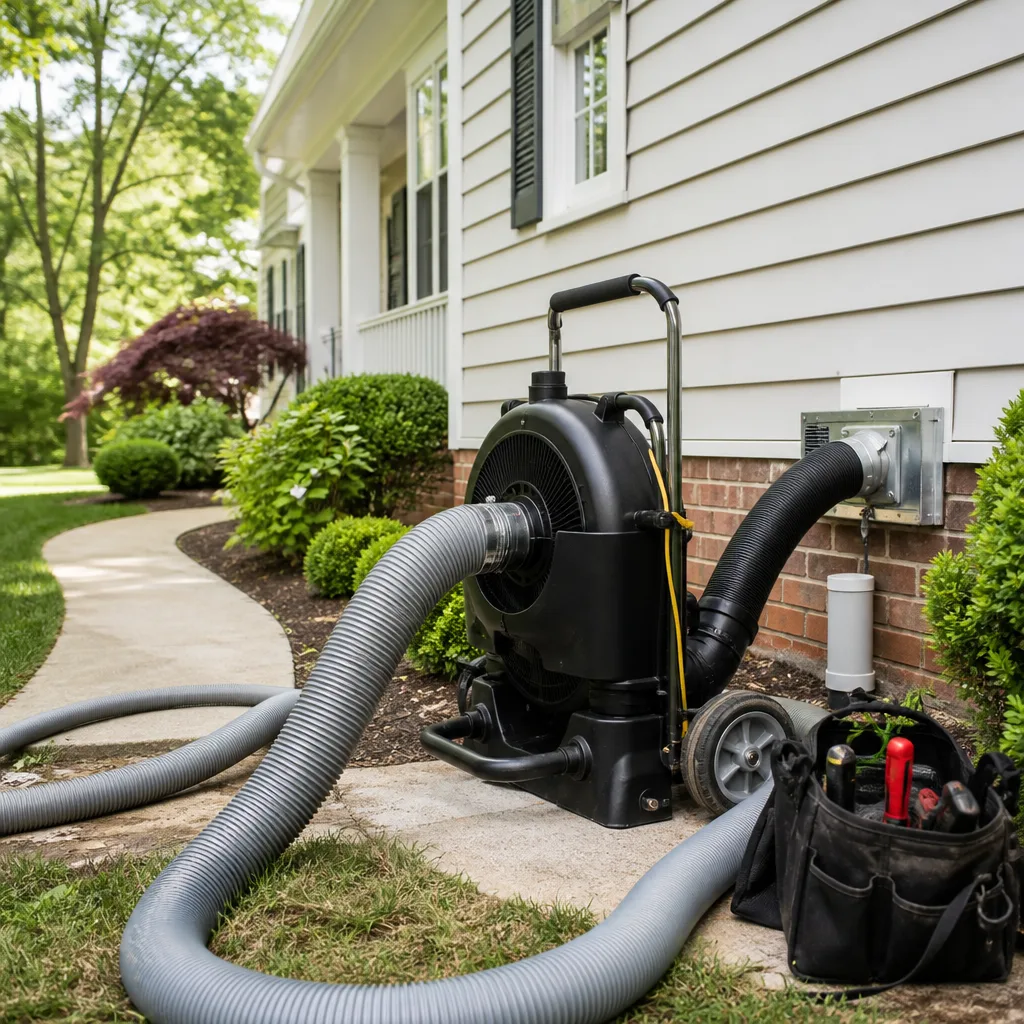 Whole-home duct cleaning
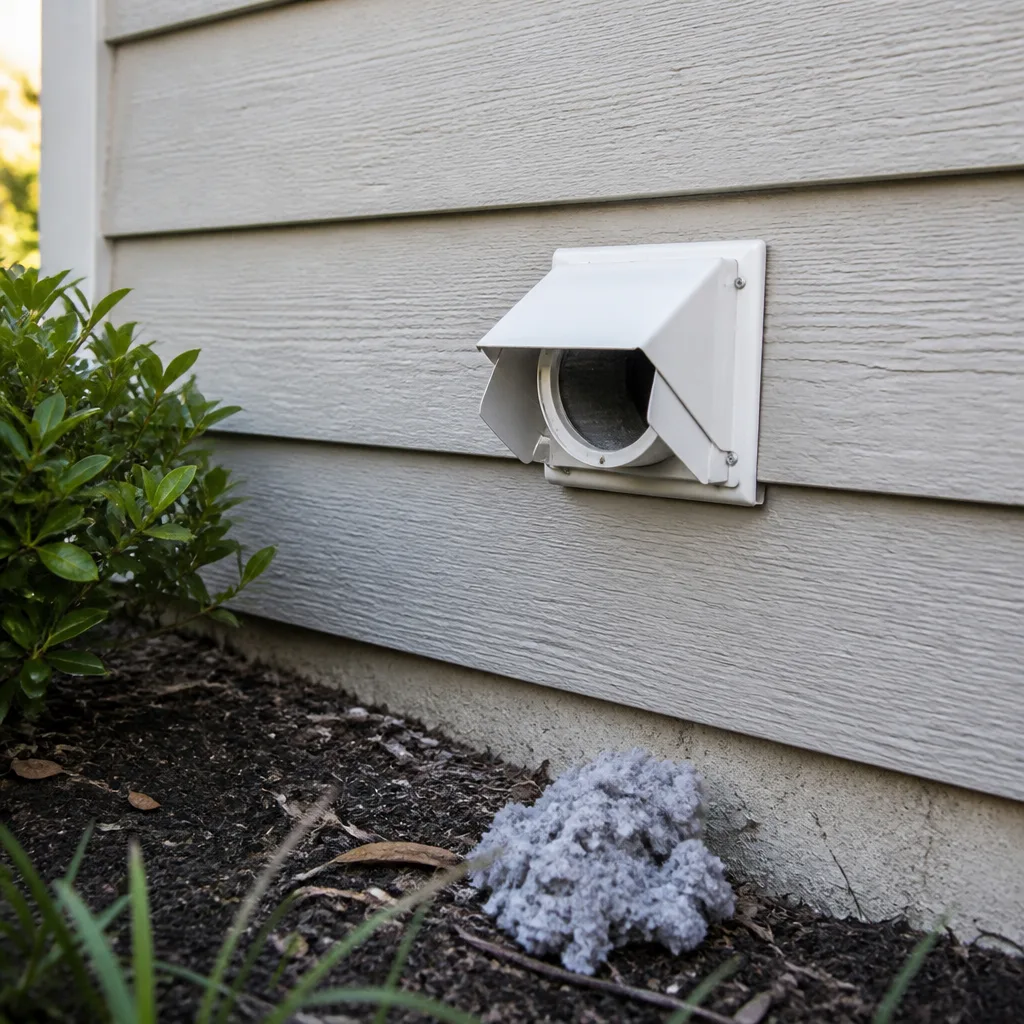 Dryer vent cleaning
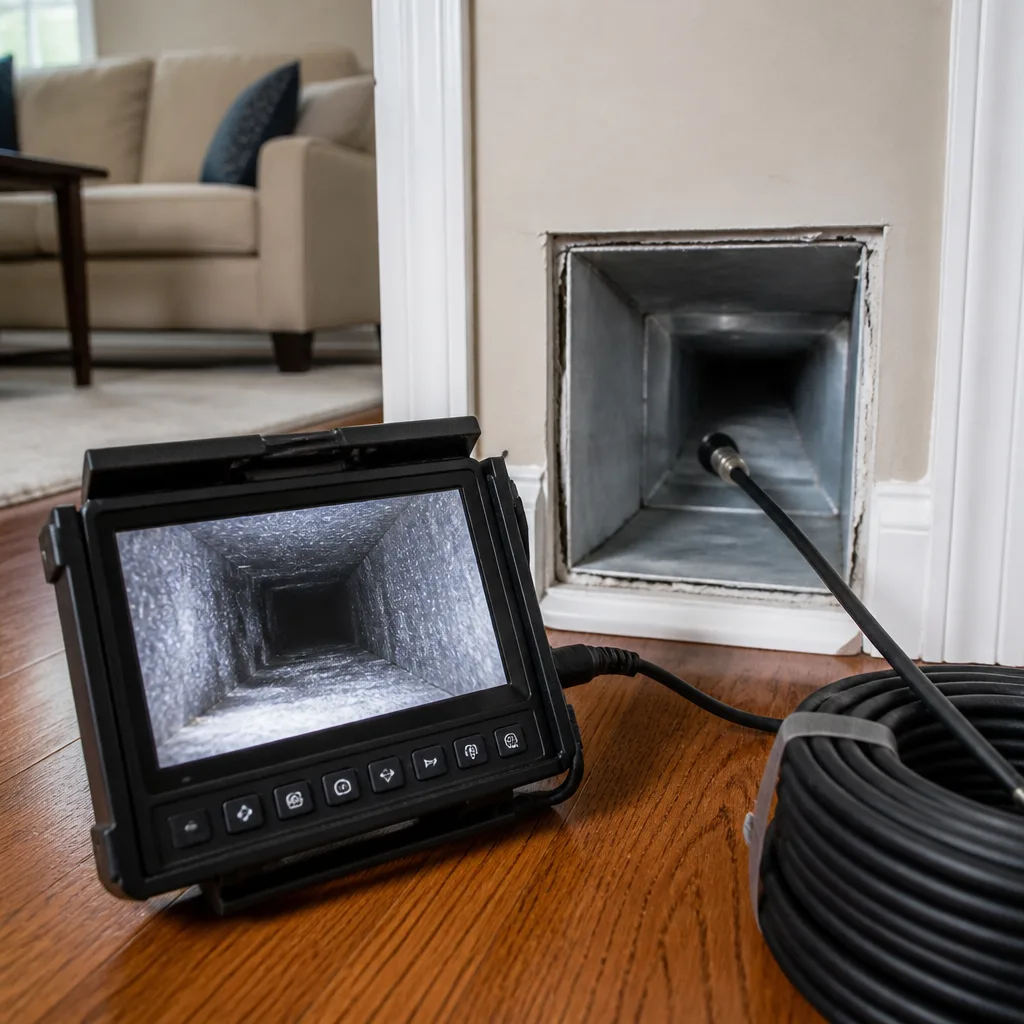 Camera inspection
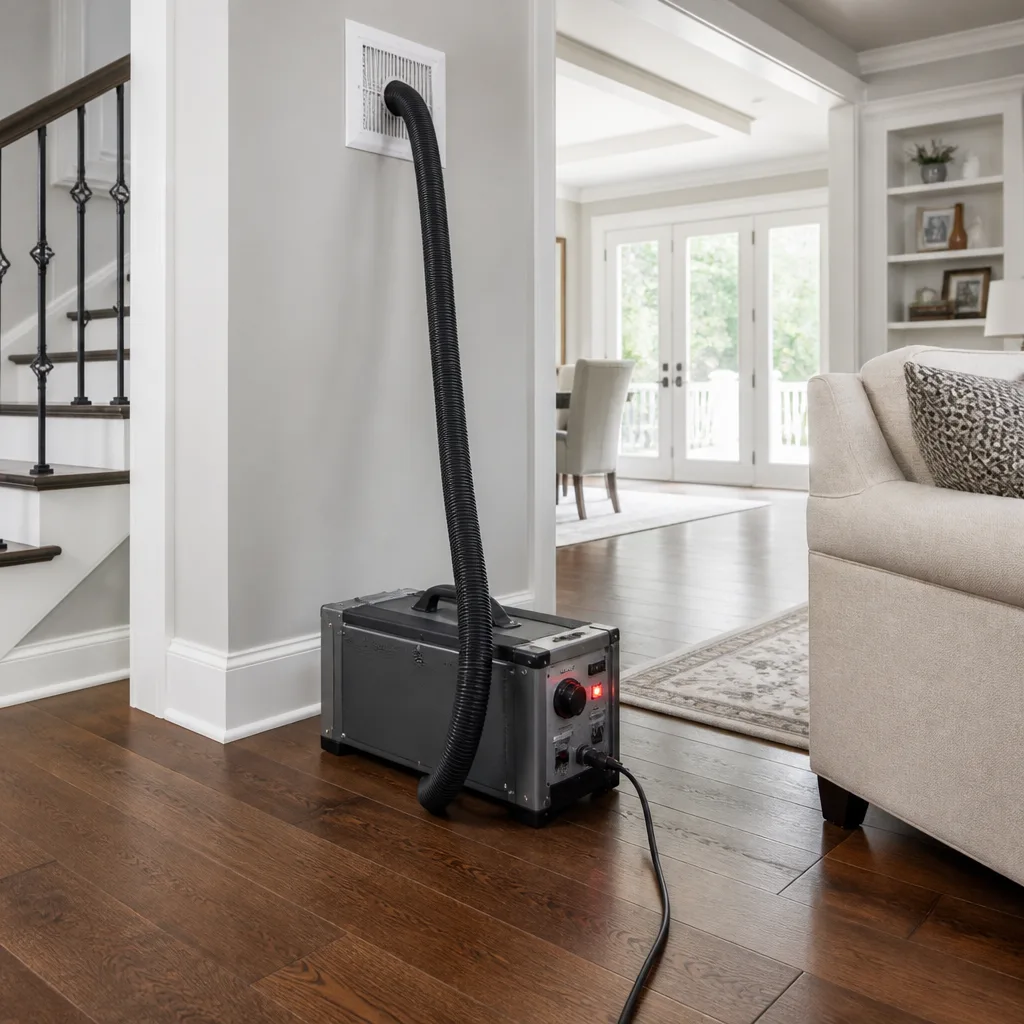 Sanitizing & deodorizing
Whole-system duct and dryer vent check with before-and-after photos - you see exactly what came out of your vents
That "$99 whole-house special" is a bait ad - the real number appears once they are in your hallway, or the "clean" is a shop-vac at the register. We photograph the inside of your ducts before and after instead.
The Complete Air Duct Cleaning Guide for Santee Homeowners
Santee sits in a bowl-shaped valley where the geography does something most homeowners never think about. When Santa Ana winds push in from the east, the surrounding hills trap airborne particulate against the valley floor, and that particulate ends up inside homes, inside HVAC returns, and eventually packed into ductwork. If you’ve been running your air conditioning and watching dust reappear on furniture within 48 hours, the problem isn’t your housekeeping. The problem is what’s moving through your ventilation system. This guide explains how Santee’s inland climate accelerates duct fouling differently than coastal zip codes, what our Air Duct Cleaning services actually look like, and how to verify the work was done correctly before you pay for it.
Quick Answer
Air duct cleaning in Santee involves connecting a high-powered negative-pressure vacuum to your duct system and mechanically agitating debris from the walls of the ducts, preventing that debris from recirculating through your home. Because Santee’s inland valley location subjects homes to Santa Ana-driven dust intrusion and wildfire-season particulate that coastal homes don’t experience at the same intensity, most Santee homes benefit from cleaning every 3 to 5 years, more often if occupants have allergies or pets. A properly scoped job uses professional-grade negative-air machines and agitation tools, not a shop vac, and it should always end with camera verification of the results.
Styles & brands we work with
- Whole-home duct cleaning
- Dryer vent cleaning
- Camera inspection
- Sanitizing & deodorizing
Table of Contents
- Why Santee Ducts Foul Differently Than Coastal San Diego Homes
- How Professional Equipment Separates Real Cleaning From Pretend Cleaning
- What a Properly Scoped Job Looks Like: Step by Step
- How Duct Material Affects Cleaning: Flex, Sheet Metal, and Ductboard
- How to Verify the Work Was Actually Done
- Dryer Vents Are a Fire Risk: Treating Them Separately
- When to Repair, Not Just Clean
- Common Mistakes to Avoid
Why Santee Ducts Foul Differently Than Coastal San Diego Homes
Homes in La Jolla or Point Loma deal with marine-layer moisture and salt air. Homes in Santee deal with something grittier. The coastal ocean breeze that moderates temperatures west of the 5 freeway weakens by the time it reaches East County, and what replaces it is dry, particulate-laden air moving through the valley. During Santa Ana events, wind speeds in Santee regularly exceed what coastal stations record, and that wind carries fine dust from inland areas directly into the residential corridor along Mission Gorge Road, Woodglen Vista, and north toward Sky Ranch.
The practical result is measurable. In our experience working on homes throughout Santee, we find a higher concentration of fine mineral dust in duct systems than in comparable homes in La Mesa or El Cajon, both of which sit at slightly different elevations and air-flow patterns. That dust is abrasive, fine enough to pass through a standard fiberglass return filter, and once it settles into ductwork it stays there until something removes it. Coastal homes might go five or more years between cleanings without obvious symptoms. A Santee home with an older HVAC system and a basic one-inch filter can show visible dust blowback from supply registers within three years or less.
Wildfire season compounds the problem. When smoke from blazes in the Cleveland National Forest or points east settles over the valley, the fine particulate works into homes through open doors, window seals, and the HVAC system itself. The heat-driven demand for air conditioning means the blower runs more hours per day during exactly the periods when outdoor air quality is at its worst. That’s not a hypothetical. It’s a pattern we see in the field across hundreds of Santee homes.
How Professional Equipment Separates Real Cleaning From Pretend Cleaning
Not all duct cleaning services use the same tools. The difference between what a professional brings and what a low-bid operator brings is measurable, and once you know the numbers, you can audit any company before they ever show up at your door.
The single most important metric in duct cleaning is CFM, which stands for cubic feet per minute of airflow a vacuum system can pull. The second is vacuum pressure, measured in inches of water gauge. A hardware-store shop vac generates somewhere between 100 and 200 CFM at perhaps 1 to 2 inches of water lift. That’s enough to pick up sawdust from a garage floor. It is nowhere near enough to pull contaminant from inside a duct run that extends 20 or 30 feet from the return plenum.
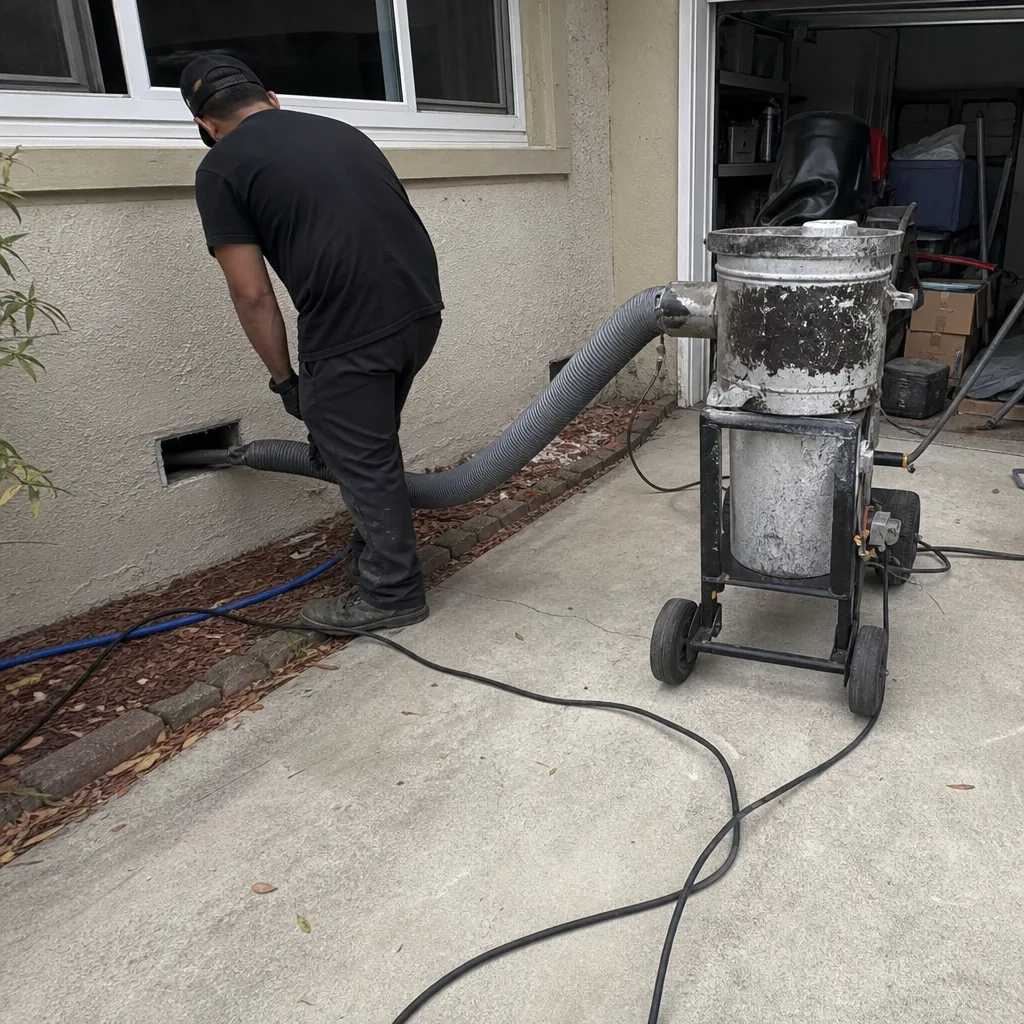
Professional-grade systems start at roughly 2,000 CFM of negative air and go up from there. Truck-mounted units often exceed 10,000 CFM, pulling hard enough that the duct walls visibly flex inward under negative pressure. This is the standard required to actually extract debris that has compacted into duct corners, joints, and flex-duct ridges over years of service. That compaction is the specific problem in Santee homes: the dryness of the air means attic duct runs accumulate dust in hard-packed layers, not the soft fluffy accumulation you might see in more humid climates. Soft fluff moves with mild airflow. Hard pack doesn’t. It requires serious negative pressure and mechanical agitation to break loose.
Brand names matter here because they represent specific tool categories, not because we’re attached to one manufacturer. Rotobrush builds rotary brush systems that spin agitation heads through the duct interior while vacuuming simultaneously. Nikro produces negative-air machines and HEPA-filtered vacuums used in commercial and restoration settings. These tools are built for the abrasive, compacted soiling patterns we see in Santee and the broader East County area, not the light dusting a coastal home might manage with a weaker system. When a contractor shows up with a toolbox and a shop vac, the job was priced for the tool, not the outcome.
What a Properly Scoped Job Looks Like: Step by Step
Knowing what a full-scope job involves gives you a checklist to evaluate any technician, regardless of company. A properly scoped duct cleaning in Santee should include all of the following steps. If a contractor skips one, ask why.
- System inspection before work begins. The technician should open the return and supply plenums and visually inspect the interior of the duct system using a camera or borescope. This establishes the baseline condition and identifies any structural damage before cleaning starts. A technician who starts cutting access points without first looking inside is guessing.
- Access point cutting. Professional cleaning requires openings cut into the supply and return trunks near the air handler. These access points allow the vacuum hose and agitation tools to reach the duct interior. The cuts should be clean, sized to accept professional equipment, and sealed properly after the job with metal patch material and mastic, not duct tape.
- Negative pressure setup. The technician will connect a high-CFM vacuum system to the ductwork. This pulls the entire duct system under negative pressure, meaning that any debris dislodged during cleaning is drawn toward the vacuum collection point, not pushed back into your living space. This is the single biggest differentiator between professional equipment and amateur attempts. Without negative pressure, agitation simply moves dust around and blows some of it into the rooms you’re trying to protect.
- Mechanical agitation. With the vacuum running, the technician works through each run of duct with a rotary brush, compressed air whip, or similar agitation tool. The agitation breaks the bond between the debris and the duct wall. The vacuum extracts it. Both must happen simultaneously. Agitation without vacuum is how dust gets blown through the house. Vacuum without agitation leaves the compacted layer in place.
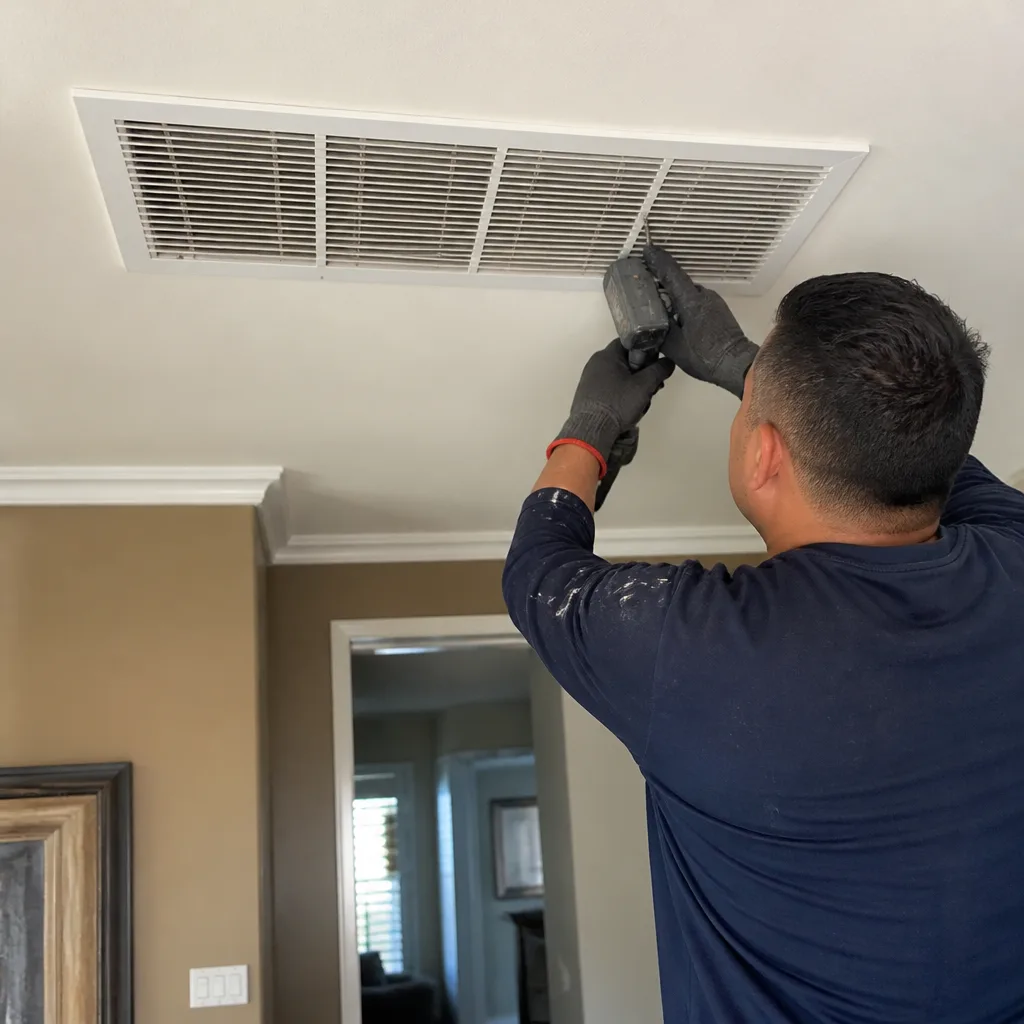
- Supply register and return grille cleaning. Every register and grille should be removed, cleaned, and if necessary replaced. This is a small step that many technicians skip, but it matters: a clean duct system blowing past dirty vent covers re-contaminates the air stream immediately.
- Post-clean camera verification. After cleaning, the technician should re-inspect the duct interior with the same camera used in step one. You should be able to see metal or clean flex-duct lining in the areas that were previously dirty. If the technician won’t show you the post-clean footage, ask for it. If it doesn’t exist, treat the job as incomplete.
We should also note: the air handler’s blower fan and coil sit downstream of some of the dirt that moves through a duct system. A serious duct cleaning has to account for what’s accumulated in the air handler cabinet itself, not just the duct walls. That’s part of the distinction between a surface-level cleaning and a job that actually affects the air your family breathes.
How Duct Material Affects Cleaning: Flex, Sheet Metal, and Ductboard
Santee’s housing stock spans several decades, and the era of construction usually determines what kind of duct material you have. That matters because each material responds to cleaning differently, and some require more careful handling.
Sheet metal ducts are common in homes built before the mid-1980s. They’re the most durable and respond best to aggressive cleaning. Vacuum pressure and rotary brush agitation work well, and because the interior surface is smooth, debris doesn’t bond tightly to the walls. Sheet metal ducts also survive repeated cleaning cycles without accumulating damage. If your Santee home was built in the 1970s, this is likely what’s in your walls and attic.
Flex duct became the standard construction material from the 1990s onward. It’s a wire-reinforced plastic tube with an inner liner and insulation wrap. The inner liner includes ridges along its spiral construction, and those ridges trap dust far more effectively than smooth metal. Flex duct responds to cleaning, but the agitation must be gentler than what you’d use on sheet metal. Overly aggressive brushing can tear the inner liner, and a torn flex duct leaks conditioned air into the attic. In Santee summers, that means paying to cool your attic while your living room never reaches temperature. Our Air Duct Repair in Santee work often begins with a cleaning crew discovering exactly this kind of damage.
Ductboard is a fiberglass product used in some 1980s and 1990s construction. Its interior surface is porous and friable, meaning it can shed particles if handled incorrectly. Ductboard cleaning typically uses lower-pressure agitation and more reliance on HEPA vacuuming. It’s also more susceptible to moisture damage and mold growth, and in cases where contamination has penetrated the fiberglass matrix, the correct move is often replacement rather than cleaning.
The takeaway: any contractor who treats all three materials identically is not doing the job correctly. The right cleaning method depends on the duct type, and that should be assessed during the inspection phase, not discovered mid-job.
How to Verify the Work Was Actually Done
The duct cleaning industry has a reputation problem, and it’s earned. The core complaint from homeowners isn’t that the work was expensive; it’s that they can’t tell whether anything happened. Duct interiors are invisible. The service is intangible. And an unscrupulous operator can charge for a cleaning that consisted of 20 minutes of noise and a receipt.
You don’t need to be a technician to verify the work. You need a $20 borescope that connects to your smartphone and 15 minutes of your time. Here’s the process:
- Before the technician starts, inspect your own ducts. Remove a few supply registers and run the borescope camera into the duct. Record 10 to 20 seconds of footage from two or three different register locations. This is your baseline.
- Do not tell the technician you’re recording. You’re not being deceptive; you’re establishing a control for verification. The work should speak for itself.
- After the job is complete, repeat your inspection at the same register locations. Compare the footage. In a properly cleaned duct, you should see smooth metal or liner surface where previously you saw dust coating. The change should be obvious, not marginal.
- If you notice partial cleaning, where some areas are visibly clean and others clearly are not, ask the technician to explain. In a properly scoped job with access points cut properly and agitation tools inserted at regular intervals, cleaning should be uniform.
This verification method puts you in control of the outcome. It also changes the conversation if you ever need to call a company back to finish a job. Video evidence of dirty duct interiors doesn’t leave much room for argument.
Dryer Vents Are a Fire Risk: Treating Them Separately
Dryer vent cleaning gets treated as an afterthought in much of the home services industry. That’s a problem, because lint accumulation in dryer exhaust ducts is one of the leading causes of residential structure fires in the United States. The fire originates when lint, a highly combustible material, accumulates around the dryer’s heating element or restricts airflow enough to cause overheating.
In Santee, this risk is amplified by the same dry air conditions that affect your HVAC ducts. Coast-adjacent cities have higher ambient humidity, which keeps lint slightly damp and slower to reach ignition temperature. Santee’s aridity means lint dries quickly to maximum flammability. Homes with longer dryer vent runs, which are common in single-story ranch homes where the laundry room sits on an interior wall, are at even higher risk because lint has more surface area to accumulate before the exhaust reaches the roof or wall vent.
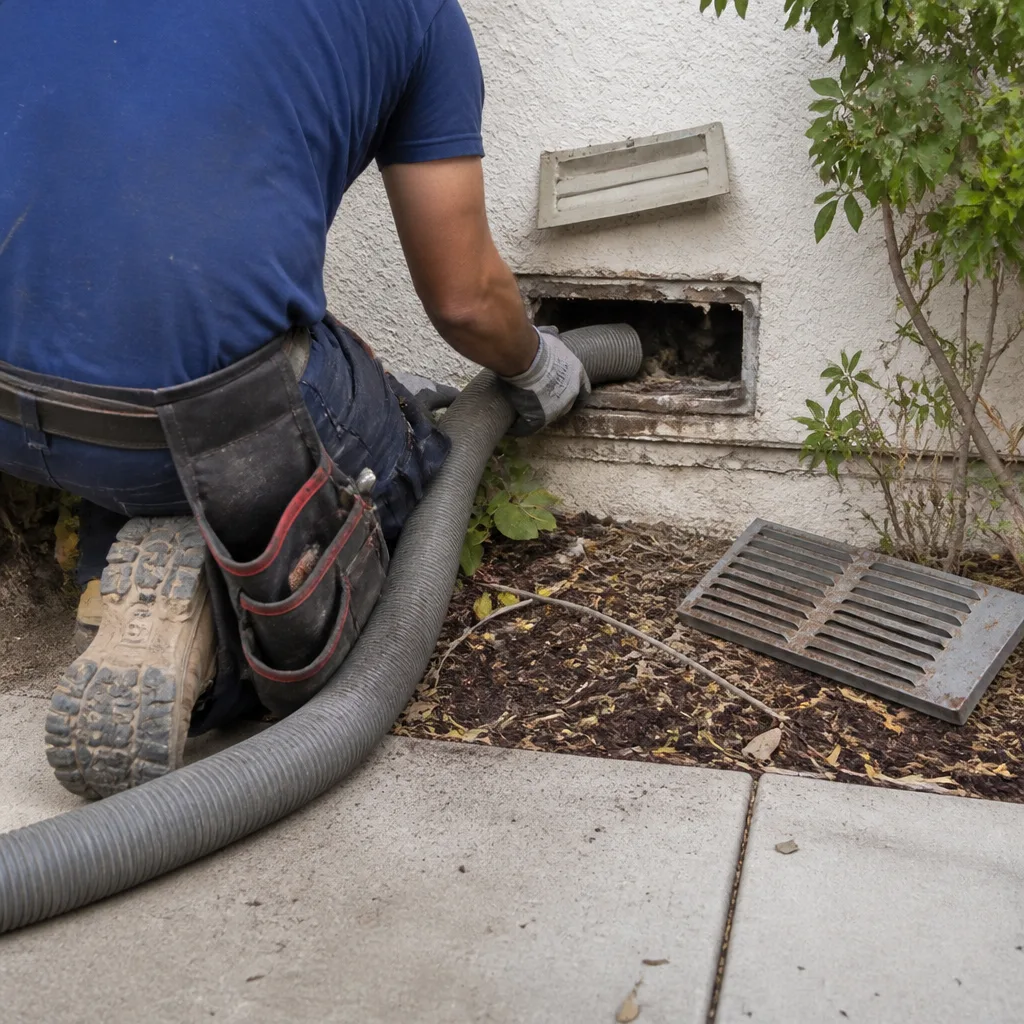
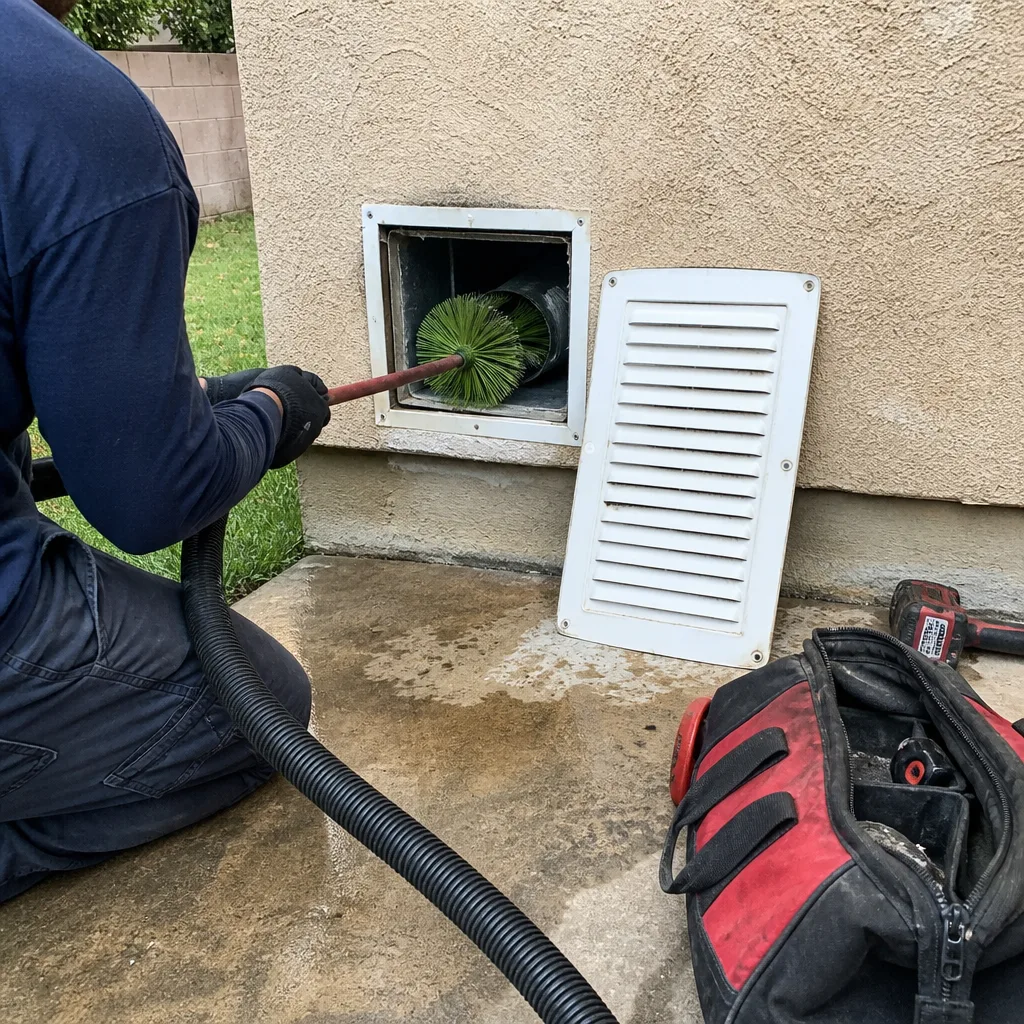
Our Dryer Vent Cleaning in Santee service operates as a standalone specialty, not as an afterthought tacked onto a duct cleaning quote. The process involves running a brush system through the full exhaust run from the dryer connection to the exterior termination, then verifying airflow with a meter afterward. If your dryer takes more than one cycle to fully dry a load, or if the laundry room gets unusually warm during a drying cycle, that’s a restricted exhaust and it’s worth addressing immediately.
When to Repair, Not Just Clean
Cleaning addresses contamination. It doesn’t address structural problems, and in some Santee homes the structural problems are the bigger issue. Duct systems in this part of East County have been subjected to decades of attic heat cycles, which means sheet metal seams can separate, flex duct can sag or tear, and insulation can pull away from duct walls. A duct system that leaks 20 to 30 percent of its conditioned air into the attic costs you money every month, regardless of how clean the interior happens to be.
This is the logic behind pairing Air Duct Cleaning in Santee with repair capability. A cleaning-only company can make a duct interior pristine while ignoring that the duct is separated at a joint three feet from the air handler. A company that does both will catch the separation during inspection and tell you before it wastes another summer’s cooling budget. Repair work includes sealing joints, replacing crushed or torn flex runs, reconnecting dislodged duct sections, and in some cases replacing sections too damaged to salvage. The objective is a duct system that delivers the air your HVAC system produces, not one that leaks half of it into insulation.
Common Mistakes to Avoid
- Choosing by price alone. A $99 duct cleaning special in Santee almost always means a technician with a shop vac, no negative air setup, and no post-clean verification. The economics don’t support proper equipment at that price point. You’ll likely end up paying for a real cleaning later, which means the cheap quote was just a tax on inexperience.
- Believing the “every 7 years” blanket timeline. Generic timelines don’t account for Santee’s specific particulate load. A home near Woodglen Vista with three dogs and two allergy sufferers might need cleaning every 3 years. A single adult in a tightly sealed newer home might go 5 years. Match the timeline to your conditions, not to an industry average.
- Accepting per-vent pricing without a system cap. Some companies quote per supply register, then label vents along the way to inflate the number at billing time. A reputable company gives you one flat price per system, agreed upon before work starts. The scope should not change mid-job.
- Skipping the post-clean inspection. If the company doesn’t offer camera verification, you’re being asked to take the result on faith. In an industry with a documented bait-and-switch problem, faith is not a reasonable verification standard.
- Cleaning without sealing leaks. Cleaning a duct system that leaks 25% of its airflow delivers marginal benefit. The leak needs to be found and fixed in the same job. That’s the value of working with a company that does both.
- Not cleaning dryer vents because “they look fine from outside.” The exterior vent hood only tells you what’s at the termination point. Lint packs against the interior walls along the full run, and you can’t see that without running a camera or brush through the line. A glowing exterior tells you nothing about the 20 feet of duct inside the wall.
- Using the cheapest fiberglass return filters. A $2 fiberglass filter stops large debris and lets fine particulate pass freely. A pleated filter with a MERV rating between 8 and 11 captures significantly more of the fine dust that Santee’s climate delivers to your return grilles. Better filtration reduces the rate at which ducts re-foul after cleaning.
See the difference
 Before
 After
 Before
 After
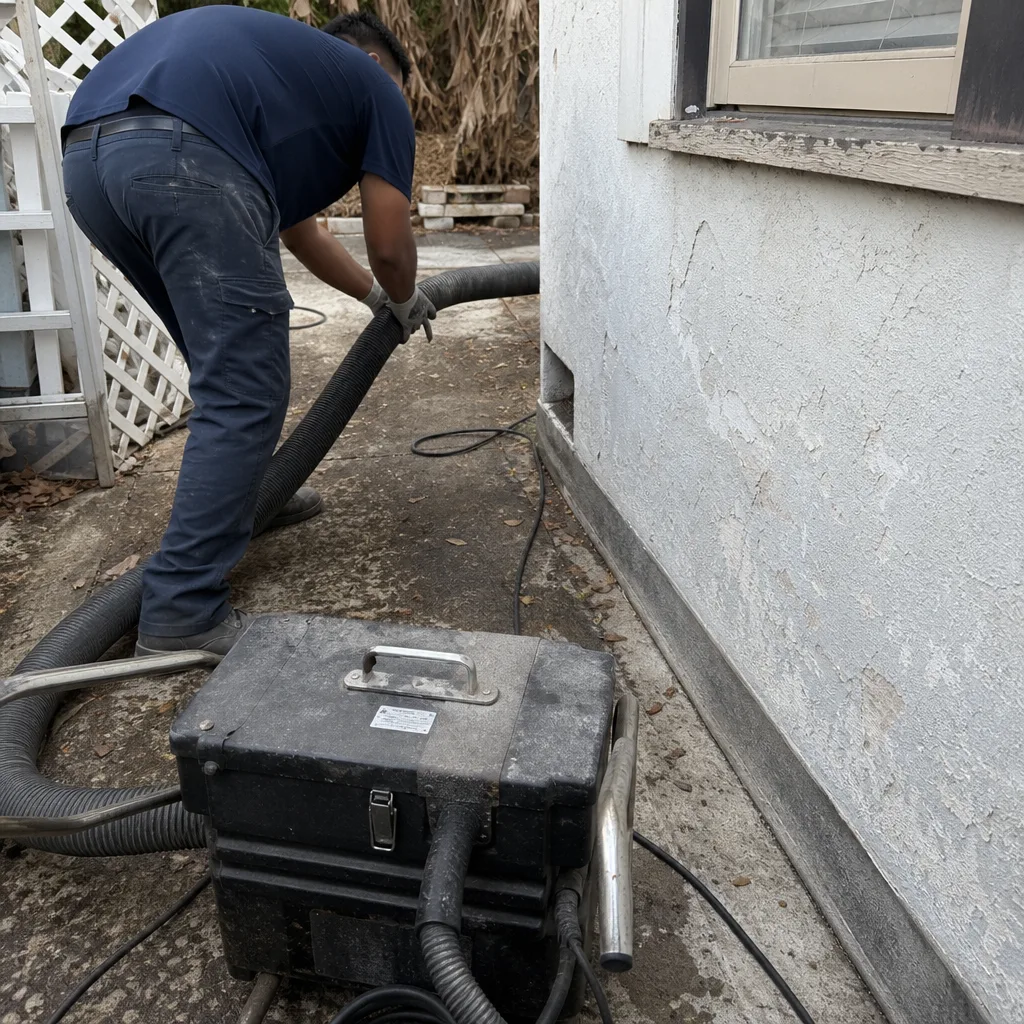 Before
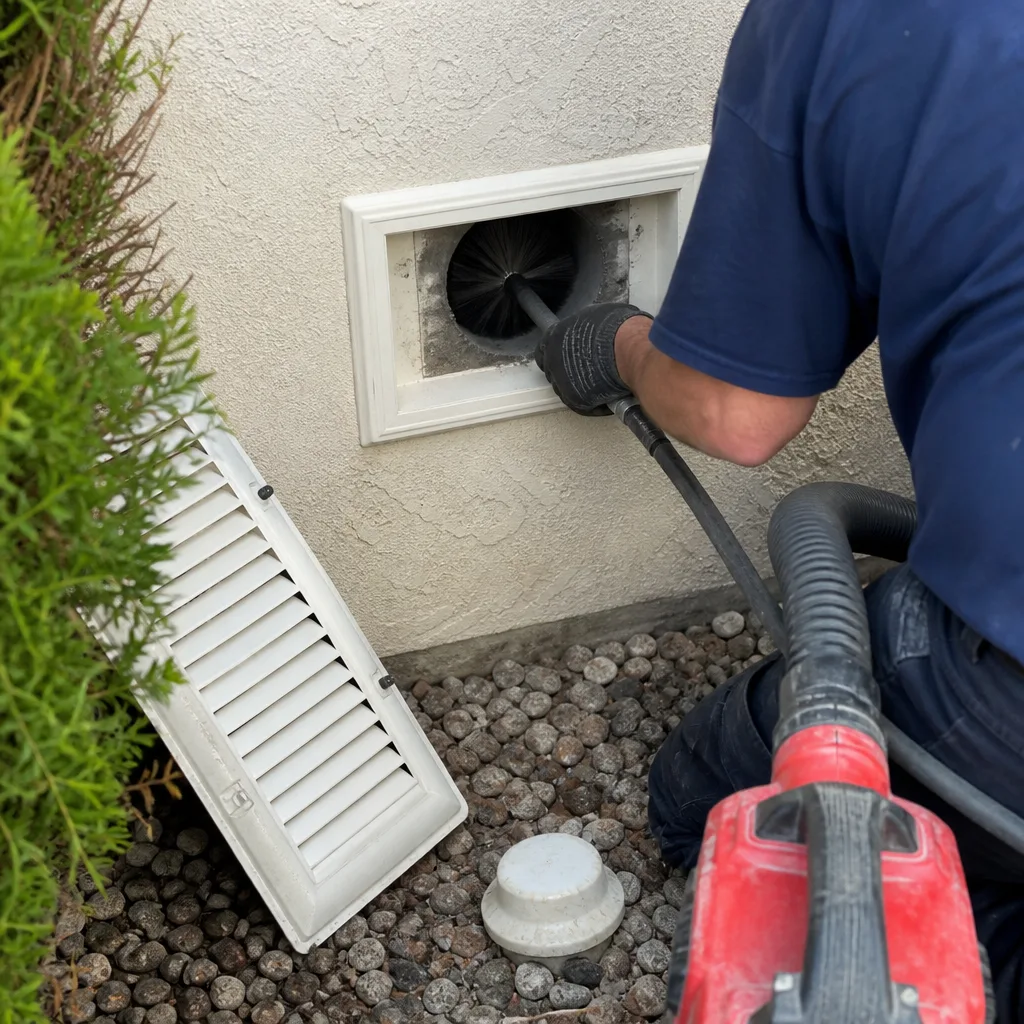 After
When to Call a Professional
If you’re seeing dust accumulate on surfaces within days of cleaning them, if your allergies intensify when the HVAC runs, if some rooms consistently blow weak air while others are fine, or if your dryer needs two cycles for a normal load, these are signs that your duct system needs attention beyond what a filter change can fix. A professional cleaning and inspection will identify both contamination and structural problems in one visit. Duct Cleaning Santee home to learn more about our services, or call (833) 542-0752 for a free estimate. We work on homes throughout Santee, including Sky Ranch, Woodglen Vista, and north of Mission Gorge Road.
Frequently Asked Questions
Whole-system air duct cleaning in Santee typically ranges from $350 to $650 for a standard single-family home, depending on the number of systems, accessibility of the duct runs, and the level of contamination present. Homes with multiple HVAC systems or severe fouling will run higher. The key is getting one flat price per system agreed in writing before work starts, rather than a per-vent quote that can expand at billing time. Call (833) 542-0752 for an exact quote on your home’s system.
Most Santee homes benefit from cleaning every 3 to 5 years, compared to 5 to 7 years for many coastal San Diego County homes. The difference is driven by the particulate load from Santa Ana wind events and wildfire season, which coats duct interiors more quickly in the inland valley. Homes with pets, allergy sufferers, or smokers in the household sit at the shorter end of that range. If you haven’t had your ducts inspected inside of three years, it’s worth having a camera look at them regardless of the calendar.
Low-bid operators typically use consumer-grade shop vacuums with air flow under 200 CFM, no negative pressure setup, and no post-clean verification. The equipment simply cannot extract compacted debris from duct interiors, regardless of how much time is spent. What the homeowner receives is surface agitation that moves dust around without removing it. When a quote seems too cheap to support proper equipment and technician training, it usually is. The job either isn’t being done, or it’s being done partially with the homeowner unable to verify the outcome.
You verify it yourself with a $20 smartphone borescope before and after the job. Record footage from the same register locations pre-clean and post-clean, then compare the duct interior surfaces. A properly cleaned duct will look visibly different: smooth metal or liner material where previously there was dust accumulation. Any professional company should also offer their own camera verification after the job. If they don’t, that’s a signal the work may not be verifiable. Video evidence of clean duct interiors is the only objective proof that the job happened.
Duct cleaning can reduce the concentration of allergens circulating through a home when the duct system has accumulated dust, pet dander, or pollen over multiple years. The blower pushes air through those contaminants every time the system runs, re-aerosolizing particles into living spaces. Removing the accumulated material from the ducts ends that cycle. That said, cleaning is not a cure for allergies. It’s one component of indoor air quality, alongside better filtration and controlling the source of allergens in the home.
You cannot meaningfully clean your own air ducts with consumer equipment. The duct runs behind walls and through attic spaces extend far beyond any reachable distance from a register, and a shop vac cannot generate the airflow or vacuum pressure necessary to extract compacted debris from the full length of a duct system. The result of a DIY attempt is usually partial surface cleaning near the registers and no change deeper in the system. Professional cleaning requires access points, negative-air machines, and agitation tools designed for duct interiors.
Duct cleaning removes contamination from the interior of the duct system: dust, debris, pet dander, and other accumulated particulate. Duct repair addresses structural problems: separated joints, torn flex duct, crushed sections, or insulation failure that causes conditioned air to leak into attic spaces. The two services are complementary because a clean duct system that leaks air still wastes energy and a sealed duct system full of dust still contaminates living spaces. Both should be addressed together when present.
The Bottom Line
Santee’s location shapes how your ducts collect contamination, and that means your cleaning schedule and verification standards should be specific to this valley, not borrowed from coastal averages. The tools a contractor brings matter, because compacted East County dust doesn’t surrender to a shop vac. The process matters, because negative pressure and proper agitation are what separate real extraction from noise. And verification matters, because you should never have to take a contractor’s word for work you can see with your own camera. If your home hasn’t had its ducts inspected with a camera in the past three years, or if you’re seeing dust, feeling weak airflow, or running the dryer twice per load, it’s time to find out what’s inside. For more guides & resources on maintaining your home’s air quality, explore our blog. Call (833) 542-0752 for a free estimate, and we’ll show you what we find, before and after.
Written by the team at Duct Cleaning Santee, serving Santee since 2017.